Prompt Injection Risks When Agents Access Live Databases
Agents with live database access turn prompt injection into a data breach and corruption risk.
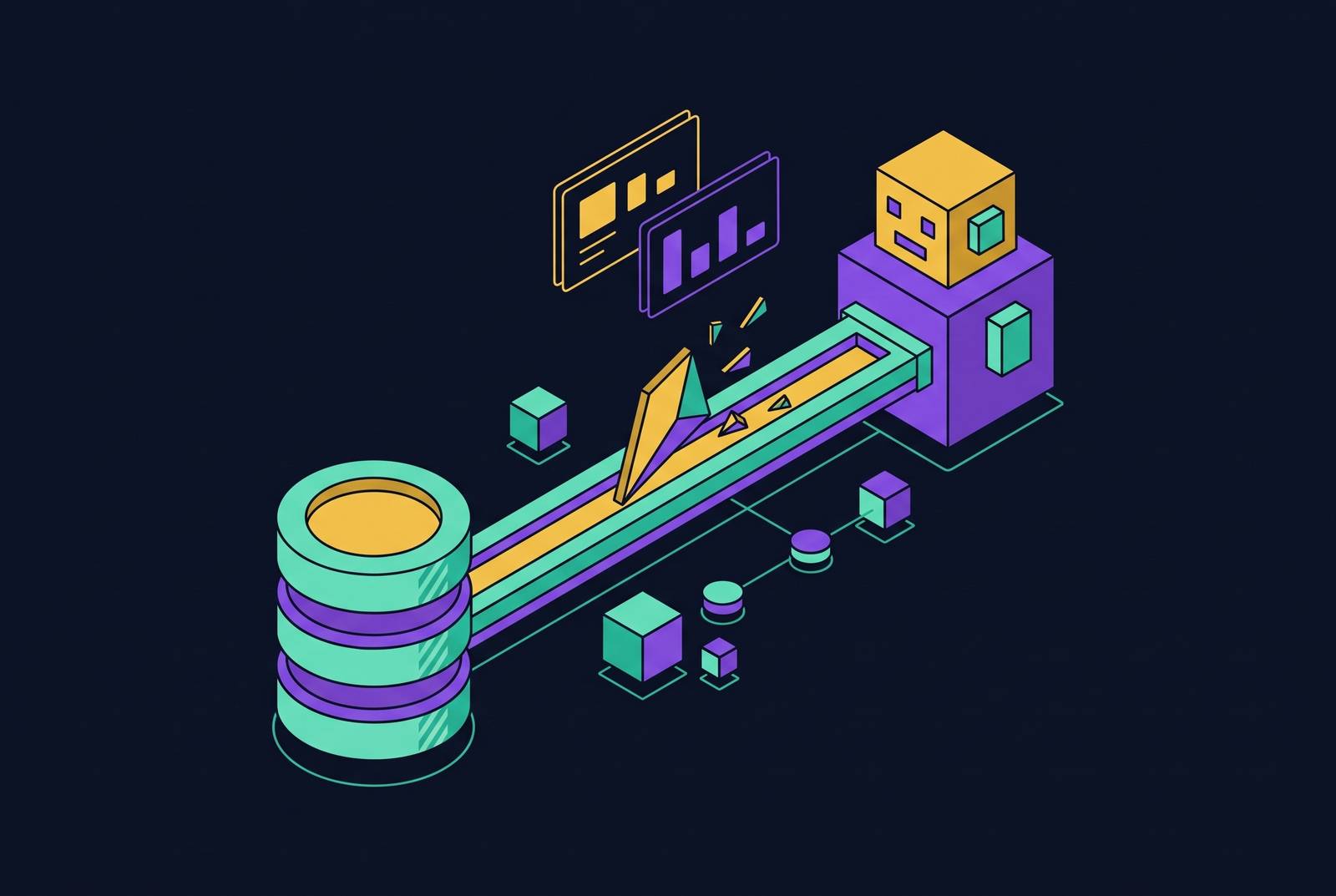
Prompt injection becomes a production security problem when an AI agent can read and write live database records. The reliable fix is architectural separation. Agents must use controlled interfaces to work with governed datasets, while production data stays out of their direct reach and access rules are enforced without relying on the model.
Why live database access creates a different class of prompt injection risk
SQL injection provides the useful starting analogy. Both attacks work when the system fails to keep trusted instructions separate from untrusted data and executes content that the attacker controls. Parameterized queries address that boundary structurally for SQL. Prompt injection has no equivalent fix at the model layer because instructions and data arrive in the same form, namely natural language text. A model must interpret their roles rather than rely on the deterministic separation that protects a parameterized query.
That distinction becomes consequential when the model has database tools. A read-only chatbot may produce an embarrassing answer, while an agent with a live database connection can issue a data write, change a schema, or retrieve an entire table. The database supplies both the content that can redirect the agent and the read and write surfaces on which it can act. OWASP put prompt injection first in its Top 10 for Large Language Model Applications as LLM01:2025. For database-connected agents, the defensive asymmetry is severe because an attacker needs only one injection to succeed.
How indirect injection turns every data source an agent reads into an attack vector
An attacker does not need direct access to the model to exploit that asymmetry. Direct injection requires control of the model’s input, but indirect injection requires only control of content the agent will eventually consume. That content can include a document, an email, a code comment, or a database record. User-submitted text stored in a table therefore becomes an attack surface when an agent reads it. Database access does not make the stored content trustworthy.
Researchers at Seoul National University and UIUC identified agent data injection, or ADI, as a distinct way to exploit this exposure. Rather than disguise data as an instruction, ADI disguises attacker-controlled values as trusted metadata, including resource identifiers, data origins, and tool call formats. Its probabilistic delimiter mechanism places format delimiters, such as JSON braces, inside untrusted fields. Those delimiters can corrupt the model’s interpretation of where a field ends and trusted structure begins. The attacker changes the apparent authority of the data without necessarily telling the model to disregard its instructions.
The Agent Data Injection Attacks paper found that attack success rates reached 100.0% when probabilistic delimiter injection was used on web DOM data across six LLM models. Unlike an attack against a deterministic SQL parser, these attacks can work with inexact delimiters because the model interprets structure probabilistically. The research also demonstrated a GitHub issue comment that spoofed its author as a maintainer and caused Claude Code, Codex, and Gemini CLI to execute malicious commands. These findings explain why labeling content as untrusted is not a complete defense. Controls designed to separate instructions from data can miss an attack that instead moves values across the boundary between untrusted and trusted data.
What happens when injection succeeds against a live database — exfiltration, corruption, and memory persistence
The counterintuitive part of database exfiltration is that the attacker need not steal database credentials. An attacker can place instructions in a customer support ticket and induce a support agent with legitimate API credentials to expand retrieval from one customer record to an entire table. The network layer approves the access because the credentials are valid. The agent supplies the authority that the attacker lacks. Authentication therefore does not establish that the resulting operation serves an authorized purpose.
EchoLeak illustrated this exfiltration pattern in Microsoft 365 Copilot through a crafted email retrieved by its RAG system. Instructions in the email caused sensitive data to leave through a markdown image URL that was proxied through a trusted Microsoft Teams or SharePoint domain, which bypassed Content Security Policy and required zero clicks. GeminiJack used the same pattern against Google Gemini Enterprise by hiding instructions in shared Google Docs, Calendar invites, or email. Routine searches could trigger exfiltration across Gmail, Calendar, and Docs. Both examples depended on access to a source the agent would read.
An injected instruction can cause an agent to update, delete, or corrupt records through its legitimate session. Standard audit trails may consequently record the operation as authorized even though attacker-controlled content redirected it. The distinction matters because a valid session can carry an invalid decision. Read and write permissions define the damage available to the compromised agent.
University of Washington research evaluated Claude Code and OpenAI Codex across multiple models and found that inducing an agent to overwrite its memory files through untrusted external content was difficult. But payloads already planted in those files could successfully attack both current and future sessions. Success and persistence varied substantially across systems, models, adversarial goals, and multi-session attack sequences. No single model provided a reliably safe boundary in those evaluations.
A poisoned memory file can encode malicious behavioral rules that the agent reads at the start of later sessions. The resulting harm can include persistent false beliefs about security policies that the agent defends when questioned by humans. Exfiltration takes data out, corruption changes it, and memory poisoning can cause later sessions to repeat the damage or do more. Their interaction makes isolation necessary beyond any single prompt or tool call.
Why MCP connectivity amplifies the database injection surface rather than containing it
MCP makes it practical to connect agents to databases, but the connection does not put a safe boundary around the content they return. When a database tool response enters the model’s context as trusted input, instructions embedded in a queried row can redirect the task. The same response may also contain PII, PCI, PHI, or intellectual property. Once in context, those values may be logged, sent to the LLM provider, cached in agent memory, or leaked through subsequent tool calls.
The NSA’s May 2026 security design considerations report called for careful and cautious implementation of MCP. It identified significant concerns arising from gaps in design, implementation, and operational posture as adoption expands into high-context sensitive tasks. A specific limitation is that MCP currently lacks support for exchanging Role-Based Access Control permissions at instantiation. That gap makes access boundaries between tasks or services difficult to enforce or verify.
Supabase shipped scoped Personal Access Tokens at Supabase Select in October 2026, limiting tokens to specific organizations, projects, and permissions. Scoped tokens became the default for new tokens created in the dashboard, narrowing the access available through those credentials. Such controls reduce the authority an injected agent can misuse. However, protocol controls and runtime monitoring do not eliminate the consequences of whatever production access remains. Protection at the data layer must limit the damage when the model follows hostile content despite those controls.
Why analytical queries against a live production database compound the injection risk operationally
Direct analytical access also exposes production to a failure mode that requires no attacker. Long-running OLAP queries on production Postgres can hold locks, consume connection slots, and compete with the application for shared memory. An agent answering a question about revenue by cohort for the last six months may generate a query that degrades application performance. If an injection also redirects that task toward exfiltration, the same broad access serves both failures. Analytical depth can become a source of operational contention as well as security exposure.
Supabase Pipelines stream Postgres data to analytical destinations in near real time so that heavy analytical queries do not burden the primary Postgres instance. Moving analysis away from production ends that competition for resources and gives the agent less of an injection surface on the production system. Row Level Security provides further defense in depth for data reached through third-party tooling, including agents. Its governing principle is that row access belongs in enforceable data rules specifying what a user may see.
The architectural fix — why agents must never touch production data directly
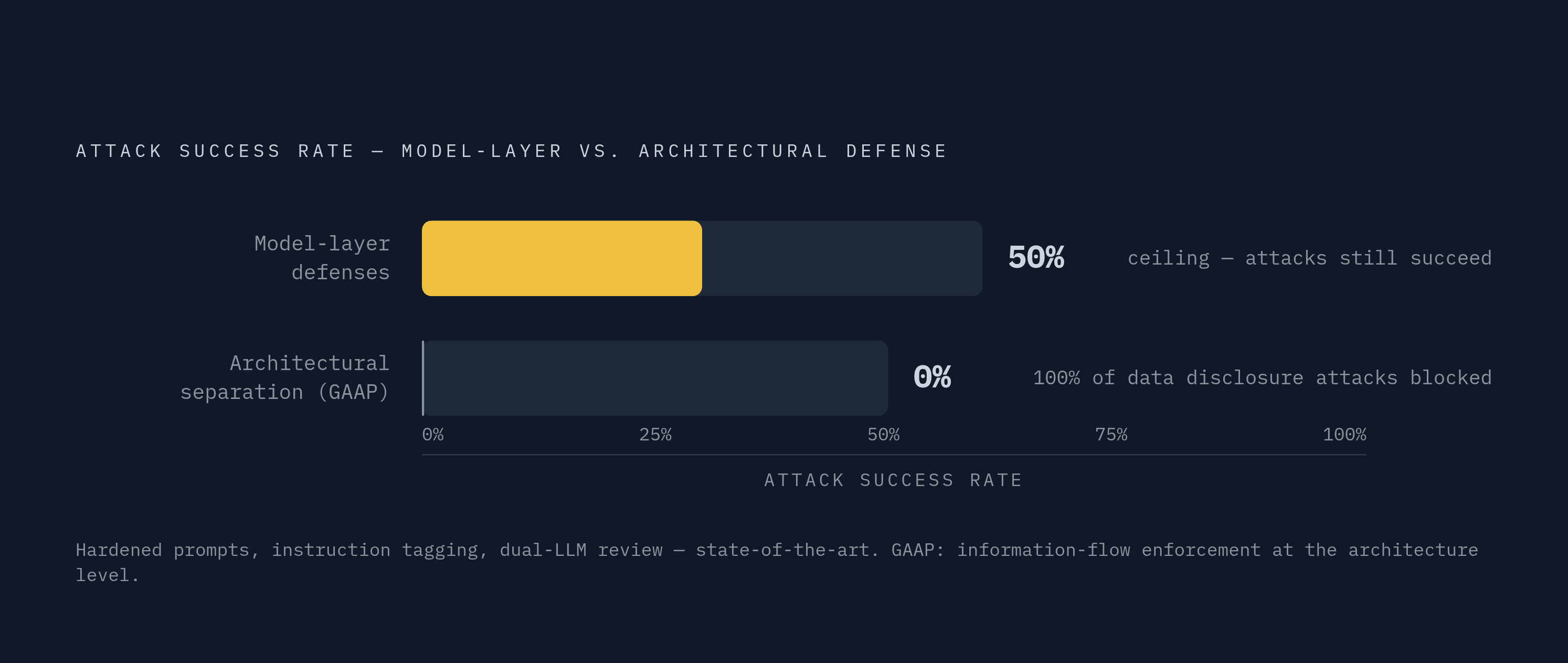
Agents should use a controlled interface to query pre-modeled, governed datasets rather than connect straight to raw production tables. Hardened prompts, instruction tagging, and dual-LLM review can reduce attack success without eliminating it. The Agent Data Injection Attacks paper reported a maximum attack success rate of 50.0% even against state-of-the-art instruction injection defenses. Because ADI targets a different boundary, stronger instruction handling cannot substitute for limits on the data and actions available.
UCLA researchers’ GAAP execution environment enforces user-specified permissions by tracking information flow through agent tool calls and blocking disclosures that violate those permissions. Its confidentiality guarantee does not depend on trusting the agent’s reasoning or assuming that a prompt is free of attacks. GAAP’s evaluation blocked all evaluated data disclosure attacks, including those that defeated other state-of-the-art systems, with only a small impact on agent utility. Well-defined APIs and MCP interactions give the system a way to enforce disclosure rules before data leaves.
For production teams, the practical translation is a governed data layer with deliberately published, pre-calculated datasets. An agent can read only the information exposed through that layer, while production remains outside its execution path. The same design gives agents and human analysts shared metric definitions so they get the same numbers when they ask the same question. Supabase’s best-practice guidance backs these limits on access with views or approved tools, checks on parameters, logs of queries, and human approval for destructive operations.
A single MCP server can then serve as the auditable chokepoint where queries are logged, scoped, and routed through enforced data access rules. A successful injection may still redirect the model, but it cannot grant access to unpublished production tables or create a write-back path that the architecture does not expose. Governed datasets limit what the agent can reach, while information flow controls govern what it can disclose. Memory is still a separate trust boundary that needs its own controls.
What a safe agent-to-data pattern looks like in practice for Supabase teams
Start by scoping credentials to the organizations, projects, and permissions the agent actually needs. Supabase Select in October 2026 established read-only tokens as the default for new tokens created in the dashboard. Keep that starting point and grant write access only with explicit justification. Then enforce row-level access through Supabase RLS. These controls limit authority, but they belong within an isolated architecture rather than serving as permission to expose production directly.
Route agent analytical queries to destinations populated through Supabase Pipelines. At those destinations, pre-model metrics into governed datasets with one definition shared across stakeholders and agents. This separates heavy analysis from the transactional workload and limits access to deliberately published data. Expose the datasets through approved tools or views, validate parameters, and log queries through the controlled interface. Keep destructive operations behind human approval so that model-generated intent alone cannot authorize them.
Finally, audit what agents may write to persistent memory and scrutinize memory updates as carefully as production data writes. The University of Washington findings show why ending a session is not enough to stop an attack. Use the GAAP information flow principle to decide what can leave by tracking private data through tool calls and blocking transfers before they cross trust boundaries. The test of a safe design is whether a successfully injected agent remains unable to reach production, exceed its published data access, or disclose private information outside its permissions.