Context-Aware Agent Responses Grounded in Pre-Modeled Metrics
Pre-modeled metrics resolve semantic ambiguity before agents reason over data.
The Model Context Protocol gives agents a channel to data, but nothing in the protocol determines which numbers are correct, which metric definition to use, or whether a queried table is the authoritative source. The missing layer is pre-modeled, governed datasets that resolve semantic ambiguity before an agent ever reasons over a schema. Teams that build this layer give every agent query a stable foundation, eliminating the confidence with which agents deliver wrong answers.
Why MCP alone cannot make agent responses trustworthy
MCP standardizes the interaction pattern between AI systems and tools, but it does not define a metric, enforce data quality, or decide which datasource is trusted. Starburst's agentic AI infrastructure guide frames data access as the key bottleneck, not model reasoning capability. The protocol solves a plumbing problem: how an agent connects to a tool, how a request is formatted, how a response comes back. It says nothing about whether the response means what the agent thinks it means.
The adoption numbers make the gap urgent rather than theoretical. Anthropic launched the protocol in November 2024, and Salesforce reported 4.5 million MCP calls processed since the April 2026 launch of its Hosted MCP Servers, with the Headless 360 MCP Server itself entering beta in July 2026. Millions of calls are now flowing through a channel that carries no inherent guarantee about the meaning of the data moving across it. An agent with raw table access but no semantic context will guess at meaning. An agent with semantic context but no query access cannot answer. Both failure modes deliver wrong numbers with total confidence, and scale only makes it louder.
The deeper problem is institutional memory. A human analyst accumulates context over years: which reports are current, which fields nobody trusts, which column is the real revenue figure. Agents arrive with none of that. If ambiguity is not resolved before reasoning begins, small errors in meaning compound into incorrect answers. The fix is not a better protocol. It is a semantic and governance problem, and it sits entirely outside what MCP was designed to address.
How agents fail when they interpret raw schemas on the fly
When an agent must derive metric meaning from raw schema at query time, it produces confident, unverifiable answers that are structurally indistinguishable from correct ones. The Redpanda Agentic Data Plane paper identifies the core asymmetry: agents are less predictable than humans and more technically capable. Hallucination, misinterpretation, and adversarial manipulation can cascade damage at machine speed through high-throughput interfaces. A wrong answer that arrives in milliseconds and feeds the next step of a workflow has already propagated before anyone notices it.
The semantic gap produces a specific failure mode: agents cannot distinguish between data they were intended to access and data they simply have technical permission to reach. The AI Agent Data Governance playbook documents agents hallucinating queries against datasets they should never touch, because nothing in the raw schema tells them a table is off-limits for a given purpose. Technical access and semantic intent are different things, and an agent operating on schema alone sees only the first.
Errors do not stay local. Multi-agent orchestration means a corrupted metric consumed by one agent becomes input to the next, and no single agent need exceed its permissions for a compliance violation to occur. The authorization gap compounds the semantic gap. The Open Agent Passport paper found that in a live adversarial testbed, social engineering succeeded against model-only controls at a 74.6% rate, while deterministic policy enforcement brought that rate to zero. The same principle applies to semantic guardrails: a probabilistic guess about what a column means is not a definition.
For Supabase teams the risks are concrete and immediate. Agents generating ad-hoc analytical queries will hit every missing index, because no human tuned the schema for the patterns an agent improvises. Connection-per-query patterns can exhaust Postgres connection limits at scale. Row Level Security bypassed at the application layer exposes multi-tenant data if a single bug creates a bypass route. These are not exotic failure modes. They are what happens when a raw data layer meets an agent with no semantic constraints.
What pre-modeled metrics actually provide that raw access cannot
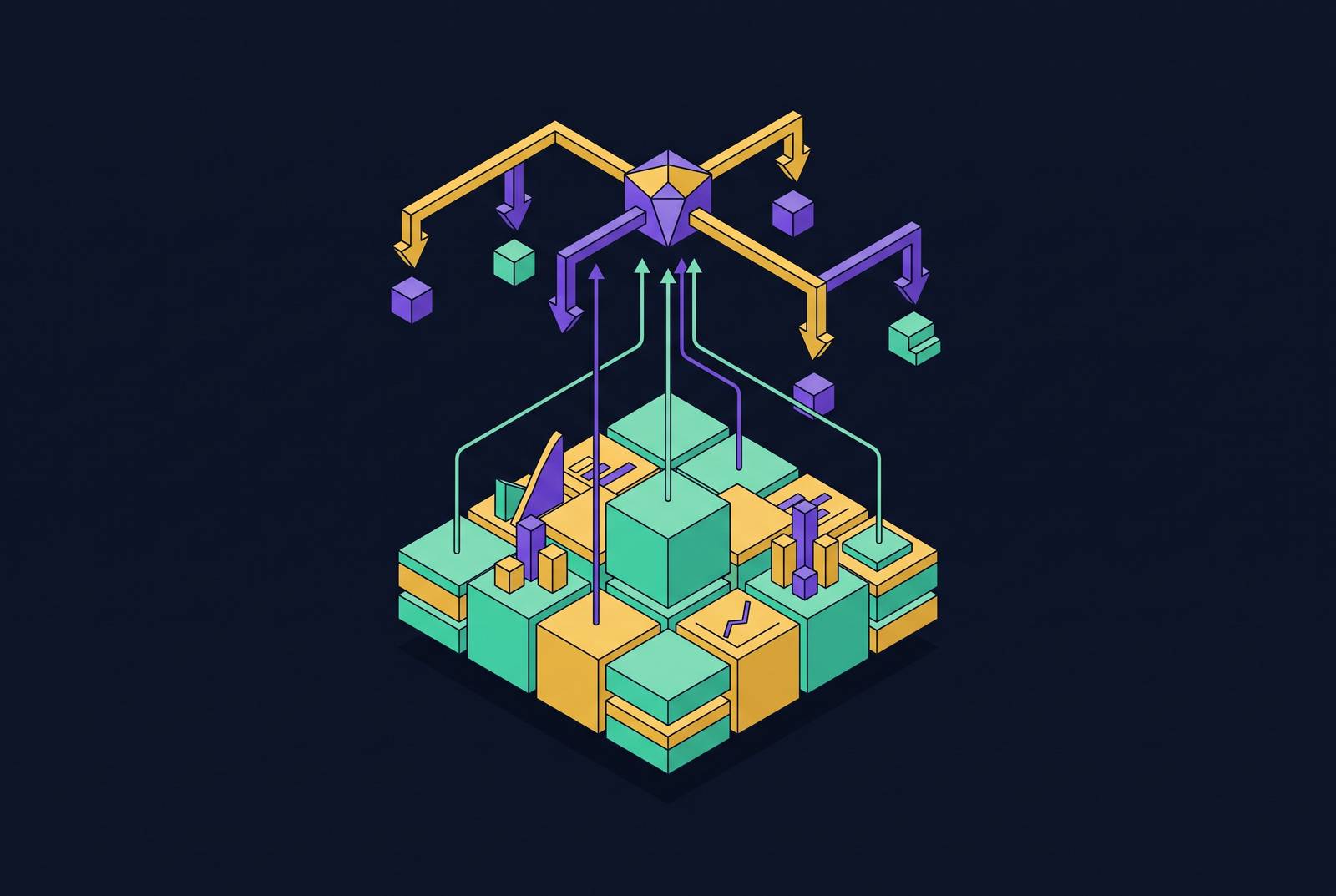
Pre-modeled metrics resolve ambiguity before the agent reasons, giving every query a stable semantic foundation that cannot be misinterpreted at runtime. The architecture separates what the data means from how it is queried. Metric definitions, business logic, ownership, and freshness are stored as structured context that agents receive before reasoning begins, not during it. Starburst's guide calls this a dedicated context layer, an agentic control plane that must ground agents in shared business meaning before they reason. It is a prerequisite, not an add-on.
A governed context graph storing metric definitions, business logic, and permissions should power dashboards, ad hoc SQL, and AI agents from the same source of truth. Splitting the model humans use from the model the AI uses produces two different answers to the same question. The single-definition principle is the entire point: one metric definition, shared across every consumer, regardless of whether the consumer is a person or an agent. Divergence between these paths is the failure the architecture exists to prevent.
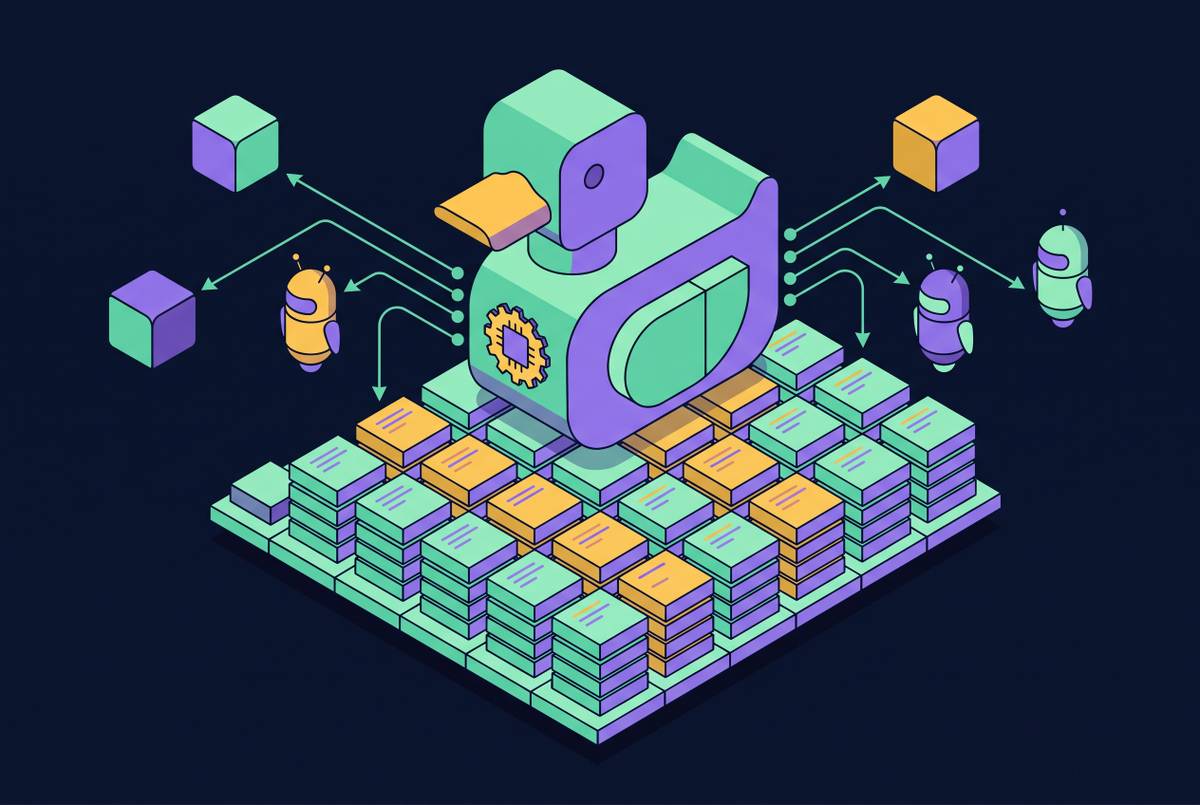
Pre-calculation matters for cost and speed as well as correctness. Agents that query pre-modeled Parquet datasets via DuckDB avoid hitting production databases entirely, eliminating connection pressure and query cost on live systems. The metric was computed once, correctly, under governed conditions. The agent reads the result. The production database never sees the agent's traffic at all.
The interface follows from the structure. An agent calling a governed metric tool that accepts a metric name, filters, and dimensions inherits the policy and provenance of that metric automatically. This is preferable to letting an agent construct an ambiguous SQL string from scratch, where the definition of revenue is whatever the agent guessed at the moment it wrote the query. Semantic tools carry meaning with them. Raw SQL carries only syntax.
Why governance must live inside the data layer, not around the agent
Session-level access control and model-alignment safety are both insufficient when agents operate continuously at machine speed. Governance that works must be embedded in the data access layer itself, enforced at the request level. The AI Agent Data Governance playbook documents four characteristics that make human-centric governance obsolete: agents are continuous, they operate at machine speed, they lack semantic context, and multi-agent interactions create data flows that violate compliance even when each individual agent stays within its stated permissions.
The implication is that static session-level permissions cannot carry the load. Governance must operate dynamically, at the request level, so every agent action is evaluated against policy. Attribute-based access control extends this beyond static roles: row-level security returns only records an agent is authorized to see, and column-level masking redacts sensitive fields even from permitted queries. One row of a financial table might be visible to a reporting agent while the customer's name in that row is masked. That is the granularity agents require.
The field has converged on a specific architectural pattern, not just a principle. The Redpanda Agentic Data Plane paper demonstrates out-of-band metadata architecture: security context, policy signals, and audit trails carried through channels entirely outside the agent's read and write path. The agent can neither see nor bypass them. The paper's multi-agent portfolio rebalancing system shows the pattern in practice, with per-client data scoping, trade approval thresholds, and tamper-proof audit trails all enforced through channels the agents themselves never touch.
The Open Agent Passport paper frames this as the pre-action authorization problem. Current architectures rely on model alignment, which is probabilistic, and post-hoc evaluation, which is retrospective. Neither provides deterministic, policy-based enforcement at the individual tool call level. OAP intercepts tool calls synchronously before execution in a measured median of 53 milliseconds and produces a cryptographically signed audit record. Policies must be machine-readable: a policy stated in prose, such as access requiring management approval, cannot be executed by a policy engine. A policy expressed as a declarative rule against a specific schema and agent credential can be. For Supabase teams, Row Level Security enforced at the database level, not conditional branching in the application, is the minimum baseline. A single bug in application-layer access control exposes all tenants.
The agent identity and lifecycle problem that governance frameworks overlook
Agents must be treated as distinct principals with documented lifecycles, not as invisible extensions of the developer or user who created them. Permissions that accumulate without explicit lifecycle management become a governance liability. The AI Agent Data Governance playbook specifies the practical implementation: an enterprise agent registry as the single system of record for what agents exist, who owns them, what data they access, and when they were created. Separate service accounts per agent specialization. Explicit retirement processes that revoke permissions when agents are decommissioned or repurposed.
The failure mode is slow and silent. An agent provisioned with broad access in one period may still execute those permissions months later, long after the underlying business purpose changed, new data classifications were applied, or regulatory requirements shifted. No human reviews the permission, because no human remembers the agent exists. A support agent and a financial reporting agent sharing API keys or database credentials creates an attribution and scope problem that makes audit investigation impossible. When something goes wrong, the logs point to a shared credential with no clear owner and no defined scope.
These are not theoretical risks. The Open Agent Passport paper enumerates production failures: 492 or more MCP servers exposed without authentication or encryption in production, 824 or more malicious skills identified in the OpenClaw ecosystem, and CVE-2026-26118, an SSRF vulnerability in Azure MCP Server exploited via valid authenticated credentials where no policy governed execution, enabling privilege escalation over the network. None of these are alignment failures. They are authorization failures at the identity and lifecycle layer. The same infrastructure that enforces spending limits can enforce quality gates and operational contracts.
For Supabase teams without a dedicated security team, the practical implication is direct: each deployed agent needs its own scoped credential and a clear decommissioning process, not a shared service account reused across workflows. Identity governance and semantic governance are two sides of the same trust problem. One governs what an agent can reach. The other governs what the data means when it gets there.
Why startups and Supabase teams face this trust gap more acutely than enterprises
Teams without dedicated data staff have no human fallback to catch agent errors. Enterprises distribute semantic knowledge across analysts, data stewards, and review processes. A startup has none of that. Starburst's guide notes that a human analyst can ask a colleague what a field means and wait for a correct export. An agent has no such recourse and cannot tolerate the same ambiguity. When the agent guesses wrong, nobody is standing by to catch it.
The typical founder pattern makes the gap worse. There is over-investment in data collection, with many tools gathering data, and under-investment in connection. Metrics stay siloed, insight never compounds, and the response to confusion is buying another dashboard rather than modeling the underlying metrics. Adding an agent to this environment does not add intelligence. It adds velocity to a fragmented data landscape, which means errors propagate faster across more surfaces.
The practical path is smaller than it looks. Starting with a small set of decision-critical metrics rather than a sprawling warehouse is more valuable than comprehensive coverage of everything collected. A governed, pre-modeled layer covering the metrics that drive the next decision beats a partial semantic layer stretched across every table the team has ever touched. Scope discipline is the advantage a small team has over an enterprise, and it is the thing most often thrown away.
The Supabase-specific infrastructure risks become acute under agent workloads. Because Postgres consumes a connection per concurrent connection, agent-generated short-lived queries can exhaust the pool in ways that user traffic never did. Composite and covering indexes that human analysts never needed become critical when agents generate ad-hoc analytical patterns at volume. A single governed data layer, with pre-calculated metrics as Parquet datasets queryable via DuckDB and exposed through MCP, means agents and human teammates consume the same numbers from the same definitions. That eliminates the divergence that emerges when agents get their own data path separate from the one people rely on.
What the full trust stack looks like when pre-modeled metrics anchor it
A trustworthy agent response is the output of a stack, not a feature of a model. Pre-modeled metrics provide the semantic foundation. Out-of-band governance enforces the access layer. Agent identity management closes the lifecycle gap. MCP-exposed metric tools are the interface agents actually call. Each layer addresses a failure mode the others cannot reach.
The single-definition principle binds the stack together. One metric definition, shared across dashboards, scheduled reports, and agent queries, is more valuable than any dashboard feature. Divergence between the number humans see and the number the agent computed is the failure the whole stack exists to prevent. When an agent answers a question about revenue, it should be calling the same metric definition a founder sees on a Monday morning report.
Metrics should be calculated ahead of time and pushed to where people work: inbox, Slack, scheduled report. This is not the same as pulling numbers on demand whenever someone remembers to check. Agents operating on pre-calculated datasets make this delivery pattern reliable rather than ad-hoc, because the computation happened once, under governance, and every consumer reads the result.
For teams building on Supabase and Postgres, this stack does not require a separate data warehouse or ETL infrastructure. Postgres is already the analytical home. The governance and semantic layer extends from it, with pre-modeled metrics flowing to Parquet for agent consumption while the same definitions power every human-facing surface. The trust problem was never about giving agents better reasoning. It was about giving them the same numbers everyone else already trusts.