AI Data Sprawl and the Single Governed Data Layer
Building a shared data governance layer before deploying agents prevents sprawl and audit chaos.

AI data sprawl is not caused by having too many agents. It is caused by agents multiplying without a shared access and governance layer beneath them, so each new one recreates the problem independently. The fix is not slower adoption or better tooling. It is a single governed data layer, built before agents are pointed at production systems, not retrofitted after the damage is done.
How AI data sprawl actually forms: the agent-multiplication trap
A team deploys its third agent. The first one connected to the CRM, the second to the support database, and this one needs billing data and a product metric. Each integration was the fastest path to value at the time. None of them share anything.
The trigger is structural, not reckless. Connecting an agent directly to the systems it needs works for the first one or two agents. The integration is simple, the access rules are visible in one place, and the audit question can still be answered by looking at a single log. What breaks is what happens at three, four, five agents. Each connection duplicates access logic. Each one scatters its audit trail across a separate system. And every schema change in a source system now ripples through every connected agent, making change management a combinatorial burden rather than a single migration.
The cascade that follows is predictable. Governance fragments because access rules get reimplemented for every agent, and those implementations drift as teams patch them independently. Audit becomes impossible because the question of what data an agent accessed now has answers scattered across disconnected logs or, more often, no answer at all. And change gets expensive because a single schema change in the CRM now means touching every agent that ever wired itself to that source.
Shadow AI, the unauthorized tools employees adopt without IT's knowledge, is only one symptom of this problem. The more consequential driver is sanctioned agents. Well-intentioned teams deploying approved agents produce the same structural sprawl when no shared layer sits underneath them. The governance gap is not about who authorized the agent. It is about whether anything governed what the agent could see and use once it was deployed.
Why sprawl is a governance failure, not a headcount or tooling problem
The root cause of AI data sprawl sits in the data layer itself, so adding agents more slowly or choosing better tools does not solve it. The failure is semantic and architectural before it is operational. Agents resolve ambiguity about what metrics mean probabilistically, because nothing in the data layer gives them a deterministic answer.
Consider the question of active customers. Marketing, finance, and product each have their own definition, refined over years of quarterly reporting and compensation disputes. An agent with no governed definition layer resolves this ambiguity however its model weights suggest, and different agents resolve it differently. The result is statistically plausible outputs rather than reproducible, auditable ones. A governed semantic layer changes this by making metric definitions, join logic, fiscal calendars, and access rules explicit and enforced before any query executes. This is a data architecture problem, not a prompt engineering problem. No instruction to the agent fixes a missing definition in the data layer beneath it.
The distinction between governance tiers matters here. Traditional data governance governs the data asset itself: tables, files, pipelines. AI governance extends this to model inputs and retrieval. Agentic AI governance governs something different: the live context assembled for a specific task. The control point is before the agent reasons or acts, at the moment context is selected. Traditional governance was designed for a slower environment, with manual classification and periodic access reviews. Agentic AI demands governance that is continuous and embedded directly in pipelines rather than applied as periodic checkpoints. The agent acts in milliseconds.
What the governed data layer must actually do — and what it is not
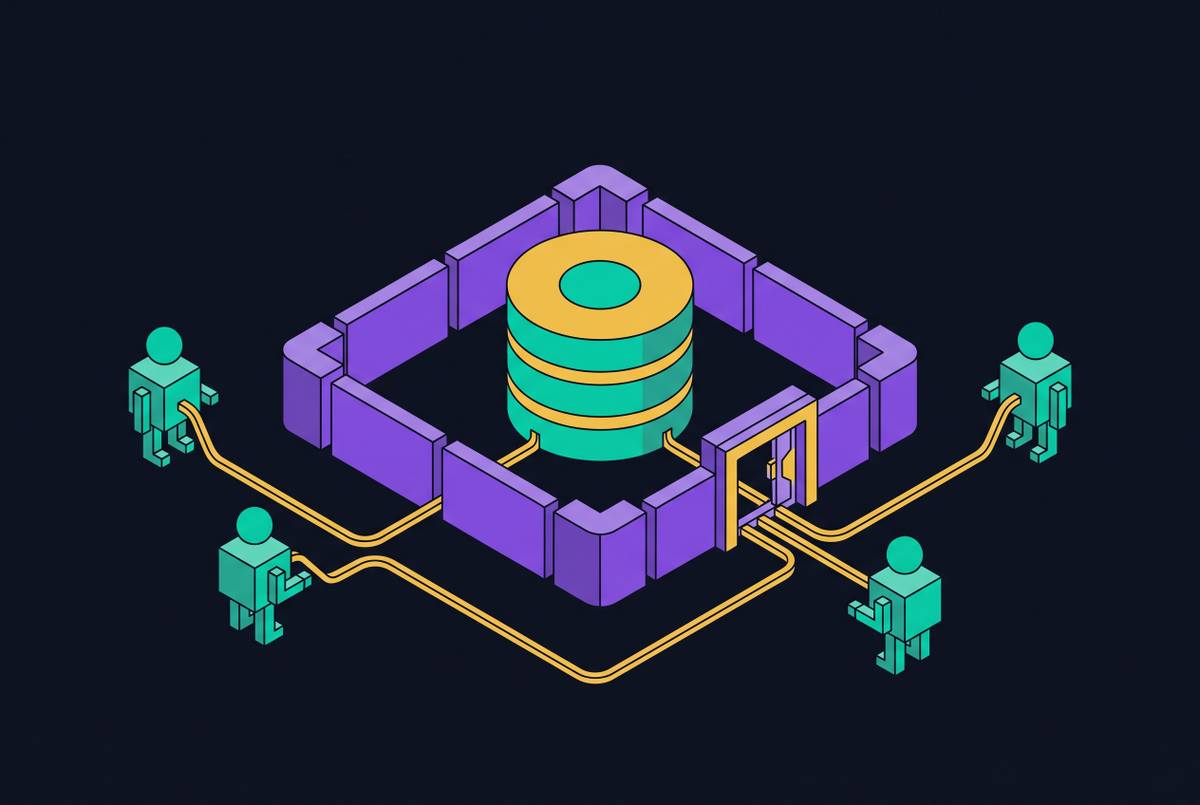
A governed data layer is not a catalog, a dashboard, or an access-control bolt-on. It is the single point through which every agent and every human receives governed, semantically grounded, auditable access to data. The architectural requirements are specific.
It must enforce one definition of every metric consistently across all consumers. The number a founder sees in a dashboard must be the same number an agent uses in a report, because both draw from the same governed definition rather than each calculating independently. It must pre-calculate and model data so agents receive governed datasets rather than raw tables. The unit of exchange is a modeled result with provenance, not an ad-hoc query result. It must log every access in one place, not per-agent and not per-tool, so audit is possible and accountability is real. And it must enforce least-privilege at query time, with row-level security returning only authorized records and column-level masking redacting sensitive fields even from permitted queries. A fraud detection agent can see transaction amounts without seeing payment card numbers because governance filters the return at query time.
What this layer is not matters as much as what it is. It is not a data warehouse migration. The architecture governs access in place rather than centralizing data into a new system first. It is not an MCP server by itself, because MCP integration requires a genuinely new architecture while existing capabilities such as catalog, lineage, quality, and access controls remain foundational but must be extended, not reinvented. And it is not per-agent governance bolted on after deployment. Agent permissions, context assembly, and MCP integration require architecture that is new in its design, not a layer applied over existing sprawl.
The practical test is straightforward. An agent needing data from five systems should make one request to one interface and receive governed results. It should not require five separate integrations built by five separate engineering teams.
MCP as the interface layer — and why it does not replace governance underneath
MCP standardizes how agents call tools and access resources, and it has earned its place as the protocol most teams reach for when they hear the words governed access. But it is an interface layer, not a governance layer. Teams that treat an MCP server as their governance solution will reproduce sprawl at the protocol level.
What MCP does well deserves acknowledgment. It provides a standard interface so agents do not each need bespoke integrations to every data source, and a centralized MCP gateway gives IT one sanctioned, audited layer rather than a sprawl of point integrations that cannot be centrally shut off. MCP integration is a genuinely new capability requiring new architecture. It is not reducible to existing catalog or access-control tools.
What MCP does not do is equally clear. An agent still needs identity, governance, semantic grounding, query performance, lineage, cost controls, and auditability. MCP provides none of these by itself. The specific risk is that agents may call raw query tools through an MCP server instead of approved metrics, bypassing the semantic layer entirely. The interface is governed, but the data underneath is not. Unmanaged MCP servers cannot be centrally shut off, which means MCP multiplies ungoverned paths as readily as point integrations when the governance layer beneath is absent.
The correct pattern for an analytics MCP server is to expose governed analytical intent. A tool accepts a metric name, filters, and dimensions rather than arbitrary SQL. The query service then enforces policy and returns results with provenance. This requires pre-modeled, pre-calculated datasets on the other side of the MCP interface. Raw database access through MCP is still raw database access.
Why Supabase and Postgres teams face this problem earliest and most acutely
Supabase teams feel the consequences of ungoverned agent access before almost anyone else because their production database is the same system handling transactional writes, analytics queries, and now agent reads. There is no separation between workloads. The workload isolation problem compounds quickly. Once analytics queries start scanning large numbers of rows, transactional latency degrades, because the production database was not designed for simultaneous analytical and transactional load. Agents hitting the same Postgres instance that handles writes make this worse. An agent querying for a metric runs a scan at the same moment a user is completing a transaction. High-volume event streams, including analytics events, application logs, and clickstream data, overload Realtime WAL processing if routed through the same instance.
The security exposure is concrete and carries a deadline. Row Level Security is the critical security boundary in a production Supabase project. RLS policies let PostgreSQL decide which rows any user or agent can read, insert, update, or delete. New tables in the public schema of new projects are no longer automatically exposed through the data API, and existing projects switch to the same default on October 30, 2026. A class of accidental exposure that used to catch teams by surprise is being closed. An agent with production database credentials and no RLS enforcement is the definition of ungoverned access. It is not a hypothetical risk but the default state of most early agent integrations.
What a single governed data layer looks like for a startup running on Supabase
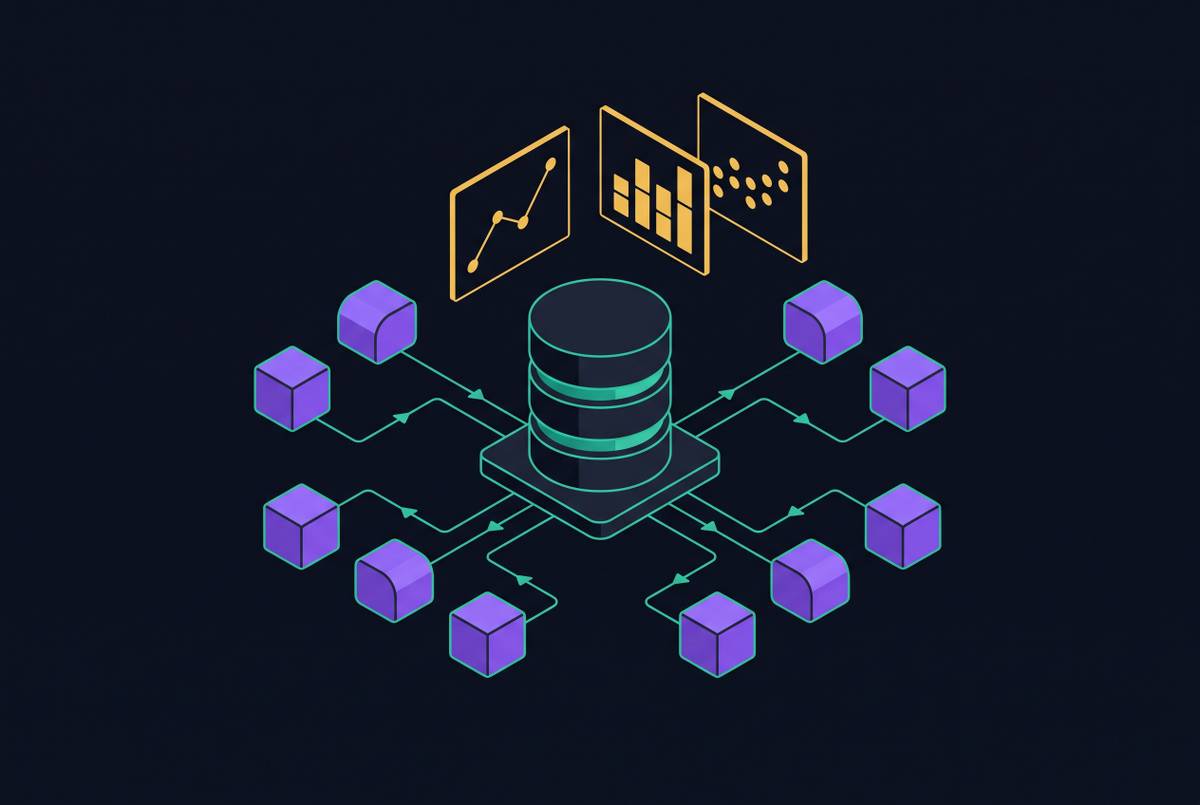
For a startup without a data team, the single governed data layer is not an enterprise governance platform. It is a pre-modeled analytical layer that sits between Postgres and every consumer of data, human and agent alike, with one definition of every metric enforced at the layer rather than in each consumer's query. In practice, metrics such as ARR, churn, CAC, gross margin, and net retention are defined once, calculated ahead of time, and stored as governed Parquet datasets queryable via DuckDB. No agent and no human writes their own version of these calculations. Agents access these datasets through a single MCP server exposed by the data layer, receiving governed results with provenance rather than raw table access. Dashboards, reports, and agent-generated summaries all draw from the same pre-calculated numbers, so the metric a founder sees in a dashboard is the same number an agent cited in a board report. Production Postgres is never in the agent's access path. The governed layer absorbs all analytical reads, protecting write performance and enforcing the isolation that Supabase workloads require.
The governed layer also enforces a discipline of restraint. Rather than tracking everything, it pre-models the metrics that drive decisions. Everything else remains available to query but is not promoted to governed status until someone owns its definition. This is operationally significant for founders. The governed layer prevents the proliferation of ad-hoc metric calculations that cause Q2 revenue to differ between the CEO's spreadsheet and the investor's data room.
The precondition for trustworthy agentic AI is governance built first, not retrofitted
Organizations that deploy agents first and add governance later will find that every agent already running has embedded the ungoverned pattern. Retrofitting governance onto a sprawling agent estate is harder than the original deployment, and the audit trail for what already happened is gone. The operational reality sharpens as agents move from answering questions to acting inside core business processes. An agent drafting claims, reconciling invoices, or triaging service requests needs controlled access to live operational data, workflows, and audit trails from the start. The context gap becomes more consequential precisely as the agent's actions become less reversible.
The strongest objection, that having only two agents means governance can wait, misunderstands where the cost accumulates. The cost of retrofitting governance rises with every agent added without it, while the cost of building the governed layer first is fixed and does not grow with agent count. AI data governance has shifted from a periodic review into a continuous, pipeline-embedded discipline. It cannot be applied retrospectively to agents that have already been accessing ungoverned data.
The unit of analytics in an agent-first world is not a query. It is a modeled, pre-calculated dataset that both humans and agents can consume safely, and that dataset must exist before the first agent is pointed at production data. For Supabase founders and operators, the governed data layer is not a cost center or a future-state aspiration. It is the architecture decision that determines whether the AI work being done now will remain trustworthy as it scales.