MCP Servers as the Data Interface for AI Agents
Governed data layers matter more than the protocol connecting agents to them.
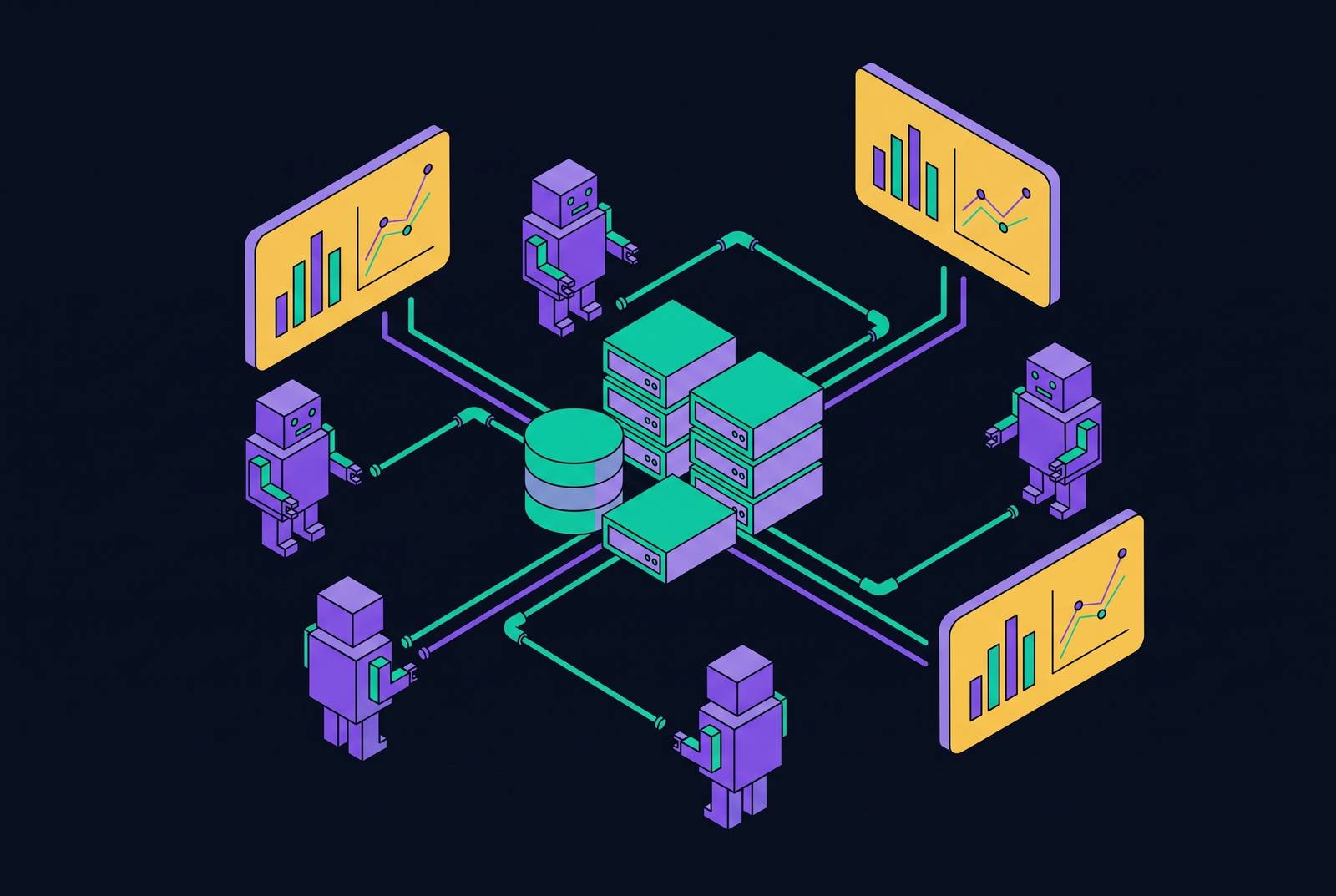
MCP servers are the standard data interface for AI agents, but analytics that teams can trust need a governed layer behind them. For API-first and agent-first teams, a headless analytics platform separates shared metric definitions from any dashboard UI. Dreambase is one option for Supabase teams that need prepared datasets through APIs and MCP.
Why MCP became the settled standard for agent-to-data connectivity
Anthropic published MCP in November 2024 as an open specification. Before that shared contract, connecting N tools to M AI platforms required N×M bespoke connectors. MCP reduces that integration problem to N+M, with each side implementing the protocol once instead of maintaining a connector for every pairing. The advantage is structural, because adding another tool or platform no longer requires rebuilding every connection.
OpenAI and Google both adopted the protocol, and the Linux Foundation's Agentic AI Foundation (AAIF) now governs it. Cross-vendor adoption and governance have made MCP the de facto standard for agent-to-data connectivity. The consequential choice is what an agent can reach through that interface and under whose authority.
The three primitives that define what an MCP server can offer
An MCP server's contract has three primitives, which are tools, resources, and prompts. Tools are executable functions that an LLM can invoke, including running a database query. They carry the greatest side-effect risk because invoking a function can do more than retrieve context. To assess a data server, teams must first check what its tools can execute as well as whether they connect.
Resources are data sources that agents can read to get context without side effects. They are a natural home for governed, pre-modeled datasets because the agent consumes prepared information. Prompts are reusable, server-defined instruction templates that shape how an agent approaches a task. Their role is distinct from access control, but they help teams keep agent behavior consistent.
The host, client, and server also have separate responsibilities. The host owns the session and enforces permissions, while each client holds exactly one connection to one server. The server is intentionally narrow in scope. This separation gives practitioners a clear way to examine both the capabilities exposed by a server and the controls surrounding their use.
Why the server is only as good as the data layer behind it
MCP standardizes access by enabling an agent to communicate with a server, but a successful connection says nothing about whether the returned data is consistent or current. When a server exposes fragmented, unnormalized sources, it passes their inconsistencies to the agent. A well-formed response can lead to a confidently wrong answer even when the protocol works as it should.
Marketing data makes the distinction concrete. When platforms use different naming conventions and schemas, querying them through a common interface does not reconcile those differences. The unified data layer must precede the MCP server, rather than emerge from the agent's interpretation of its results. Dreambase, an MCP analytics server built on Supabase, embodies this pattern by pre-calculating metrics and surfacing them through governed datasets.
Freshness is a separate requirement within the same architecture. Operational agents can need sub-minute data freshness, and a fraud detection agent using hours-old data can approve transactions based on conditions that have since changed. Even with a consistent definition, stale inputs are still stale. The governed layer must address both, while the protocol provides the route to its output. MCP is solved infrastructure, but the quality of the layer behind it remains the unresolved part for many teams.
What safe agent-to-data access actually requires
Safe access begins with least privilege and a centralized gateway that enforces permissions and logs access. Agents should never have credentials for the production database stored in their configuration. Their requests should pass through the gateway, making the permitted route part of the architecture rather than a convention agents are expected to follow. In implementations such as Dreambase, a read-only semantic layer mediates agent data requests and provides full audit trails. Governance is then a property of the path to the data.
These are familiar security principles, but agents compose multiple access patterns within a single workflow. A control that appears sufficient for one isolated request may not address the whole sequence. Traditional governance built around batch processing and periodic audits is therefore insufficient for agents that continuously ingest and process data. Access must be observable in real time at each data touchpoint and decision node.
MCP's authorization model also distinguishes delegated access from an agent acting independently. OAuth 2.1 with PKCE supports a delegated, user-consented authorization-code flow. Autonomous agents that authenticate as their own principal without a user need the separate Client Credentials extension. That distinction matters because an audit trail must preserve whose authority a request exercised. Treating both paths as interchangeable would blur the identity boundary the authorization system is meant to establish.
Read-only enforcement illustrates why the mechanism matters as much as the label. Demoting an agent to a read-only database user provides a direct first gate. By contrast, the Postgres MCP reference server attempted to enforce read-only access by wrapping queries in a BEGIN TRANSACTION READ ONLY block. SQL injection bypassed that protection through COMMIT; followed by arbitrary statements, and the reference server was archived in July 2025 with no security patches. A read-only intention is not equivalent to an enforced permission boundary.
How Supabase teams connect agents to Postgres today, and where the limits appear
The Supabase MCP server is the right starting point for connecting an agent to a Supabase Postgres project. Its scope controls include read_only, project_ref, and feature-group selection, all configured in the connection URL. The read_only flag demotes the agent to a read-only Postgres user. Pinning project_ref locks the server to one project, and choosing feature groups limits which tool groups the agent can use.
That scope reflects the server's development-time purpose. Supabase MCP offers a broader write surface by default than the generic Postgres MCP server's read-only-by-design approach. For agents that only do analytics, the latter's use of READ ONLY transactions had the right safety goal, though the reference server's bypass shows why that design alone cannot keep data safe. Teams must compare how the servers enforce their rules and which operations they allow. Neither a broad toolset nor a narrow one establishes the quality of the analytics returned.
Even a perfectly scoped Supabase MCP connection can still point an agent at raw production tables. Those schemas support transactional reads rather than pre-aggregated metrics with consistent business definitions. Restricting the project and removing write access does not decide how an analytical measure should be calculated. It also does not turn production tables into a prepared dataset. Supabase MCP handles project access, while production analytics needs a separate layer that gives governed answers when the same questions come up again.
Why pre-modeled, governed datasets are the right analytics backend for agents
For teams asking how to add usage analytics to an AI agent without a prebuilt dashboard UI, the answer is a headless analytics backend. Its unit of consumption is a pre-modeled, governed dataset. Metrics are calculated ahead of time, defined once, and made available independently of their presentation. A dashboard, Slack alert, or agent can then draw from the same source.
This is the core headless BI principle. The analytics and metrics backend is separate from the interface that displays or uses its results. For API-first teams, that separation lets them use prepared metrics without having to use an opinionated frontend. For agent-first teams, MCP supplies a standard interface to the same layer.
A governed semantic layer also changes what the agent must infer. Instead of writing separate SQL and inventing a definition for each request, the agent queries pre-approved metrics. In this architecture, the server exposes only what has been pre-approved and pre-modeled, so ungoverned fields and ad-hoc queries are outside its available surface. That restriction comes from the layer and the server's exposed capabilities.
Definitions still need an owner. One person should own each metric and act as the final arbiter of what a term such as “CAC” means. Without that owner, definition drift returns within weeks, and agents take on the disagreement without any sign that it has happened. Technical controls can keep an agreed definition in place, but people still have to agree on it.
Governed Parquet datasets queryable through DuckDB provide a concrete implementation of this pattern. Agents get context from files that are fast and cheap to query, and those queries never touch the production database. For Supabase builders, Dreambase applies this approach to prepared datasets and shared metrics rather than leaving each agent to reconstruct them from transactional schemas.
How a single MCP server exposing a governed data layer serves both agents and people
Once that governed layer exists, the same prepared data can serve people as well as agents. Separate pipelines for dashboards, reports, and alerts are no longer needed simply because each consumer has a different interface. Metrics should be pushed to where people work, including inbox, Slack, and mobile, rather than depend on someone remembering to retrieve them. The push report and the agent's answer can draw from the same pre-calculated dataset. Delivery changes, but the underlying number does not.
Microsoft's SQL MCP Server illustrates the direction of enterprise connectivity. It is open source, works across SQL Server, PostgreSQL, Azure Cosmos DB, and MySQL, and exposes data operations as MCP tools. That makes it relevant where the task is connecting agents to those database systems. Supabase MCP, by comparison, gives Supabase builders project-scoped development access. With either connection pattern, teams still need to define the metrics that a production analytics agent will use.
For Supabase teams that need that prepared analytics layer, Dreambase is one option. It exposes pre-modeled metrics in governed Parquet datasets, queryable through DuckDB, through a single MCP server. Agents do not touch the production database, and human teammates receive the same numbers through dashboards and push reports. The implementation requires no ETL, schema changes, or separate data warehouse.
The parallel is headless CMS, which separates content from presentation so different frontends can consume it. Headless analytics similarly separates metrics from any single dashboard, allowing an agent, tool, or teammate to consume them through the same API or MCP endpoint. The practical test is whether an agent and a human analyst can both ask “what was our MRR last month” and receive the same number from the same source without either touching the production database. If they cannot, the governed layer is missing.