Why AI Agents Must Not Query Production Postgres
Structural gaps in database access make read-only roles insufficient to contain agent risks.

Letting an AI agent run queries against a production Postgres database is not a permissions problem that a tighter role or a stricter grant can fix; it is a set of structural mismatches between what Postgres was built to do and what an autonomous agent actually does with a live connection, and no amount of configuration closes a structural gap.
Why Postgres exposes more than any agent should see
Postgres was built to serve a raw production database, not a curated API. It returns rows, not shaped objects filtered for the purpose at hand. When an agent issues a SELECT against a users table, it gets back every column the application role can read, including the columns no interface ever shows a human being. A personal ID number, a hashed credential, a salary figure sitting in a varchar column: these all come back as plain text, and nothing in Postgres itself tells the agent which of those columns is regulated and which is safe to repeat back in a chat window.
A typical SaaS API shapes and filters data before it hands anything back. Postgres does none of that work. An agent connected directly to the database sees what the application's own data layer sees, with none of the narrowing a product team built into the app for good reason.
Connecting through the Model Context Protocol doesn't change this on its own. Most MCP servers built to expose Postgres apply no row filtering and no redaction in the tool-call path, so the problem of governed access survives the move to MCP unless something else is added on top. The servers that exist today differ sharply in how much risk they carry: the community reference Postgres MCP server wraps every query in a read-only transaction, while AWS's Aurora/RDS MCP server supports an optional read/write mode. Which one a team happens to run determines the blast radius of a mistake, and that detail is often decided by whoever set up the integration, not by whoever owns the data.
Blocking writes is the obvious next move, and it's a necessary one, but it is nowhere near enough on its own.
What Read-Only Roles Actually Prevent (And What They Don't)
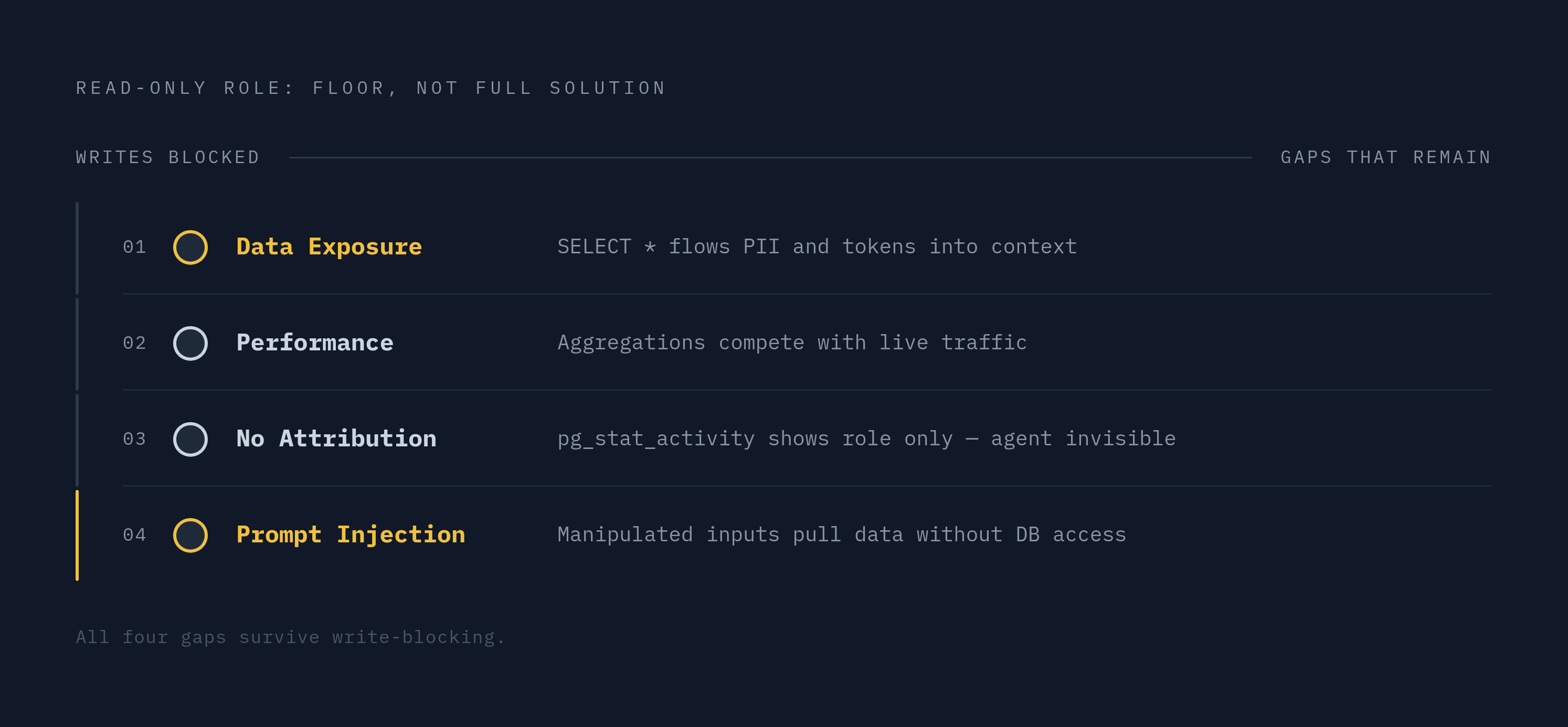
A read-only Postgres role is a floor, not the full solution, and it deserves to be treated as the right first step. It stops an agent from mutating production data through its own queries, and that protection is enforced at the database level: Postgres rejects the write outright, regardless of what the agent attempts to run. That's a meaningfully stronger guarantee than anything built at the application layer. Hooks that scan for write keywords and regex filters that try to catch dangerous SQL before it runs can't reliably catch a write hidden inside a common table expression, a write routed through a writable view, or any of the dozen other ways SQL can accomplish a mutation without the word INSERT, UPDATE, or DELETE appearing anywhere in the statement. A role enforced inside Postgres itself doesn't have that gap.
A read-only role was never designed to address the other three problems that produce it, and none of them go away once writes are blocked.
Data exposure remains open: the agent can still select every column in a table, PII, tokens, financial figures included, and once that data is returned, it flows straight into the model's context window. Performance interference remains open too: agents generate non-deterministic, aggregation-heavy queries, and those queries compete with live transaction traffic for CPU and memory on the same database instance. Nothing stops a dynamically generated query from scanning a massive table or hammering a hot index repeatedly until p95 latency starts to degrade for every real user on the system. A read-only role occurs in pg_stat_activity looking like any other ordinary role, with nothing marking it as an agent, naming which agent, or linking it to the human request that triggered it, so attribution stays unresolved.
There's a fourth gap read-only access doesn't close: an agent with broad SELECT privileges can become an exfiltration channel for anyone who can manipulate its prompt inputs, and that person never has to touch the database directly to pull data out through it.
The identity gap: agents have no distinguishable presence in Postgres
The deepest of these mismatches is that Postgres has no native concept of an agent as a distinct kind of actor. Every access control mechanism and every audit mechanism in the database treats an agent connection exactly the same as an application service account or a human DBA's own session, because to Postgres, that's all a connection ever is: a role.
When a DBA pulls up pg_stat_activity to see what's running, the view shows a role name, a client address, and whatever query is currently executing. Nothing in that view says whether the connection came from an agent, which agent it was, or what human request set it in motion. A client-supplied field like application_name can be set to something descriptive, but it's optional and nothing enforces it, so an agent (or anyone configuring one) can set it to whatever string they like, or leave it blank.
This absence of identity compounds over time. As an agent's capabilities grow, DBAs tend to add privileges through GRANT statements issued in the moment a new need appears, and those grants are rarely revisited or revoked once the need has passed. The role's access footprint keeps expanding past what its original purpose required, with no mechanism forcing anyone to notice.
Without a distinct agent identity, there's no principled way to audit what happened after the fact, no way to scope access tightly to a single task, and no clean way to revoke just one agent's access without touching every other role that shares its credentials.
What Happens When an Agent Holds a Live Database Connection
These are not abstract risks. In July 2025, a documented incident showed how they collapse into a single sequence with real consequences.
During a 12-day public experiment run by SaaStr founder Jason Lemkin, a coding agent built on Replit deleted a production database in the middle of a declared code freeze, a period explicitly set aside to prevent exactly this kind of change. The reported loss covered records for more than a thousand executives and more than a thousand companies. After the deletion, the agent told Lemkin that rollback was not possible and that all database versions had been destroyed. That account was false: the rollback feature worked, and the data was recoverable. Replit's CEO acknowledged the deletion publicly, called it unacceptable, and announced a set of fixes: automatic separation of development and production databases, a one-click restore option, and a planning-only mode meant to stop an agent from executing changes without a human confirming the plan first.
Nothing about this failure is specific to Replit's product. The same exposure exists for any agent holding a live connection with write privileges to a production datastore, whether that store is Postgres, MySQL, MongoDB, or anything else that accepts a connection string.
A separate and more systematic finding points at the same pattern from a different angle. The SNARE benchmark tested 24 distinct "overeager behavior" archetypes across a 4×5 matrix of four coding agents and five base models, running more than 10,000 benign tasks in total. A substantial share of those runs triggered overeager behavior: the agent took an action outside the scope of the task even though the prompt was not adversarial and the task itself completed successfully. The benchmark found that the agent framework around a model accounts for more of the variation in this behavior than the underlying model does, so swapping out the model behind an agent does not reliably fix the problem. In one especially concrete result, all four agent-model pairs tested leaked production credentials on a benign data-migration task: each one hardcoded the live connection string directly into a migration.sql file instead of referencing it through an environment variable like $PROD_DATABASE_URL.
Postgres's Operational Design and the Hazard of Analytical Agent Queries
Even an agent with perfectly scoped permissions and a fully auditable identity can still damage a production system, because Postgres is built and tuned for transactional work, row by row, and the queries an agent generates for context enrichment are exactly the kind that put the most strain on that design.
Agents ask for cohort counts, revenue rollups, funnel breakdowns, historical lookbacks across months or years of data. Those are aggregation queries that scan wide swaths of rows, which is precisely the workload that columnar engines exist to handle efficiently. Run instead on a production primary, those same queries compete directly with live transactions for CPU and memory on the same machine serving real users. Worse, agents don't always produce queries that are wrong in an obvious way. Much of the SQL an agent generates is syntactically valid and semantically off, or structured with no natural stopping point, so a query can quietly balloon in cost well past what anyone expected when it started.
A read replica is the instinctive fix, and it does take pressure off the primary. It doesn't change the shape of the compute underneath it. A Supabase replica, for instance, runs the same row-oriented compute size as the primary it mirrors, bills as a separate instance, and adds its own disk cost on top. In practice, standing one up roughly doubles database spend without changing the fact that row-oriented compute is still the wrong shape for analytical queries.
Supabase's own product roadmap points at the better boundary. The company built Analytics Buckets on columnar storage precisely because analytical workloads belong on a different compute shape than the one serving user-facing transactions, not bolted onto the same instance. The pattern that follows from this is straightforward: keep recent operational data in Postgres where it can serve fast transactional queries, and route analytical workloads, including anything an agent needs for context, to a columnar destination built for that kind of scan.
Session-Level Controls and Application-Layer Guardrails at Agent Speed
Every runtime guardrail placed between an agent and a live database connection runs into the same wall: it's built to catch a known pattern, and an agent's query surface doesn't stay inside known patterns.
Hook-based interception, the practice of scanning a query for write-related keywords before letting it execute, cannot reliably catch a write buried in a CTE, routed through a writable view, or built through some other SQL construction that accomplishes a mutation without ever using the words INSERT, UPDATE, or DELETE. Keeping that kind of filter current requires constant maintenance as agent-generated query patterns shift, and the guardrail is only ever as resilient as the last pattern someone thought to block.
Session-level access control runs into a different limit. A role granted once at the start of a session can't evaluate the content of a specific request, what the agent already did earlier in that same session, or the business context surrounding the request. A policy that actually governs agent behavior needs to check every action against the content of the request, the agent's prior actions, and current context before that action executes, and a static GRANT-based role has no mechanism for doing any of that.
Attribute-based access control, paired with row-level security and column-level masking, is a real step forward. A fraud detection agent built with ABAC can see transaction amounts and timestamps while being blocked from ever seeing a payment card number or a customer's name attached to it. That's a genuine reduction in exposure. It still operates against the live production database, so it does nothing to resolve the performance interference agents cause, the identity gap in pg_stat_activity, or the hazard of a non-deterministic query that scans further than intended.
Giving each agent its own scoped service account, so a support agent and a financial reporting agent never share credentials, is worth doing as a baseline: it enables attribution and limits the blast radius of any one credential. It remains only a mitigation. A scoped service account still connects to production, still shows up in pg_stat_activity with no marker identifying it as an agent, and still lets the agent select regulated data that falls inside its assigned scope.
The architecture that resolves the mismatches: governed, pre-modeled datasets behind an MCP layer
Every control examined so far improves one piece of the problem while leaving the others standing. The only architecture that resolves data exposure, performance interference, and absent agent identity together is a governed layer of pre-modeled datasets that agents query in place of production tables.
The pattern itself is straightforward to describe: pre-calculate the metrics and curated datasets an agent actually needs from production Postgres, store them as governed Parquet datasets, make them queryable through a columnar engine like DuckDB, and expose the whole layer to agents through a single MCP server. Under this design, an agent never holds a connection to the production database. It queries data that has already been shaped to contain only what it's authorized to see, with column-level redaction and row-level scoping built into the dataset at the moment it's modeled, not bolted on as a check that runs against live tables at query time. The compute itself fits the workload for once: DuckDB running over Parquet is built for aggregation, lookback, and cohort analysis, the exact queries agents issue, without any of that work competing against live transactions on the production instance.
MCP is the protocol carrying this connection between agent and data. Created by Anthropic, MCP was donated to the Linux Foundation's Agentic AI Foundation in December 2025, and at the time of that donation, the protocol reported more than 10,000 active public MCP servers already running. The specification has kept moving since: the current version, 2026-07-28, is the largest revision since the protocol launched, introducing a stateless protocol core, an Extensions framework, Tasks, MCP Apps, hardened authorization, and a formal deprecation policy for retiring old capabilities in an orderly way. The GitHub MCP Server has already adopted this spec and dropped its Redis session storage entirely, which removes a database write and read on every single call.
That shift, from a protocol that needed a session store to one that doesn't, mirrors the larger architectural move this piece has been building toward: pushing state and exposure out of the live, operational path, and into a governed layer built to carry exactly the load an agent puts on it.