Designing Analytics API Contracts on Postgres for Supabase-Native Product Teams
Explicit grants and RLS policies create a secure, auditable contract for analytics APIs on Postgres.
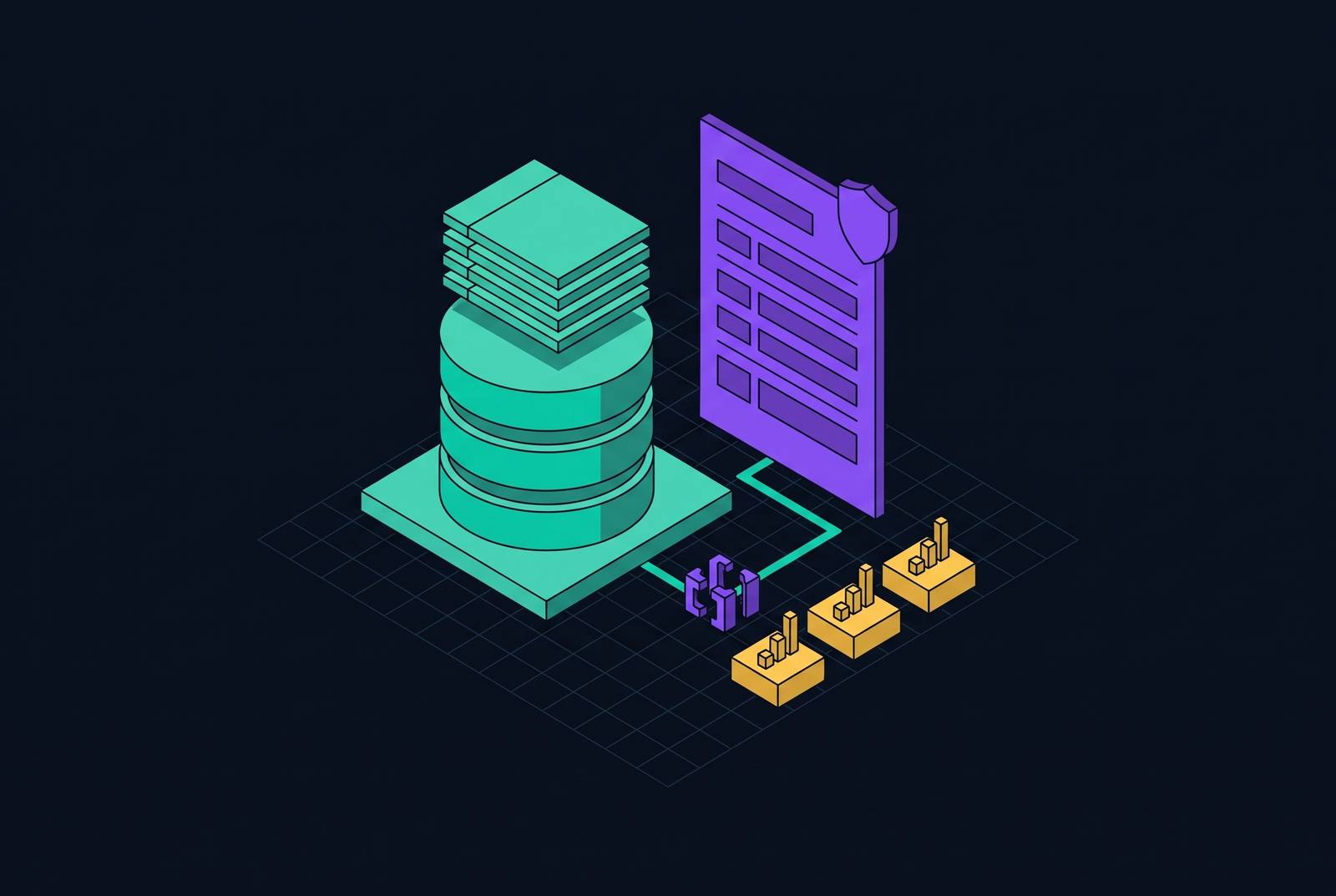
For Supabase-native teams that want a headless analytics platform with full API control and no opinionated frontend, a governed analytical copy served through a shared API and MCP layer is the best fit. Explicit grants, RLS policies, and pre-modeled datasets form its contract. That contract lets human interfaces and AI agents consume the same metrics without making production Postgres their analytics backend.
Why the October 2026 Data API grant change is an architectural inflection point, not a maintenance task
Supabase’s explicit-grant change makes table exposure a deliberate part of schema design rather than an automatic consequence of creating a table. The supplied rollout timeline begins before October 2026. Opt-in became available for new projects on April 28, 2026, and the gradual default rollout for new projects began on May 30, 2026, over a few weeks. Existing tables keep their current grants and can still be reached through the Data API. Tables created after enforcement require explicit grants.
Previously, a table could become exposed before anyone reviewed its RLS policies or intended access patterns. Under explicit grants, exposure requires a statement that belongs in the migration and can be reviewed with the schema. This moves the access decision to the point where the team defines the data. For analytics, that decision includes whether a table belongs on the application’s API surface at all.
How AI agents as first-class Data API consumers make grant design more consequential than it was for human developers
When agents author most schema changes and API calls, migration-time access rules become the system’s practical security boundary. Human developers can receive corrective guidance and pause before extending an access pattern. Agents act at automation speed without that informal review step. Leaving an access decision implicit while execution becomes automatic creates risk. For MCP integrations, prompts and configurations therefore need grant statements as part of table creation, completing grants before later human intervention.
The service_role key bypasses RLS and is intended only for server-side administrative operations. An agent using it operates outside the row-level safety boundary, regardless of how carefully its prompt describes permissions. The recommended default is an anon or authenticated client, with an explicit switch to service_role only for an operation with written justification. Under RLS, authorization remains the database’s responsibility on every query, so an agent’s forgotten endpoint check does not itself make a forbidden row available.
The two-layer contract, what grants control versus what RLS enforces, and why both layers are required
Grants and RLS answer different access questions. Grants specify a role’s table access and permitted operations. RLS determines which rows that role can read or modify within the granted surface. A public read grant without RLS leaves rows publicly readable, while RLS without the necessary grants leaves the table inaccessible through the Data API. Neither layer replaces the other.
Each role serves a different kind of consumer: anon is for unauthenticated access, authenticated is for signed-in users, and service_role is for administrative paths that bypass RLS. The first audit step is to query information_schema.table_privileges for those three grantees, identifying what the API already exposes. Internal audit logs and system tables that should remain outside that surface receive no Data API grant, even though they exist in the database.
Why analytics workloads cannot share the same access surface as transactional queries — and what breaks when they do
A secure transactional surface is not automatically a suitable analytical surface. Per-user RLS policies can correctly serve application requests while being unsuitable for a BI service account that needs broad scans. Accommodating that account means either accepting a bypass exception or adding analytics-specific policies to the production authorization model. Pooler limits then constrain concurrent, long-running queries, while JSONB columns that accelerated application development remain opaque to much analytics tooling.
Compute introduces a separate source of contention. A row-oriented instance tuned for lookups, inserts, and updates must compete with live traffic when asked to scan and aggregate large event tables. More primary compute can handle the load, but as dashboards grow, they can keep needing a larger instance. A read replica isolates some query work without changing the underlying analytical fit. It uses the same compute size as the primary, receives no compute credits, and adds disk at 1.25× the primary’s size, roughly doubling database spend in practice.
That expenditure still buys single-source, row-store analytics. The replica retains JSONB friction and does not provide joins to external billing or CRM sources. Meanwhile, complex RLS policies with joins or subqueries can slow large-table queries, especially when policy columns lack indexes. The operational recommendation is to run EXPLAIN ANALYZE after enabling RLS and index user_id, tenant_id, and other policy filter columns. The separation case therefore rests on total cost, including compute, security exceptions, and architectural friction, rather than a blanket claim that production analytics is always wrong.
Where should analytics queries run on Supabase, given Analytics Buckets and the pg_duckdb acquisition?
Supabase Analytics Buckets provide a native destination for analytical workloads outside the production row-store. They use columnar storage built on Apache Iceberg and AWS S3 Tables. Replicating application data into this layer allows analytical joins with external sources such as Stripe, CRM, and ad data without assembling a separate warehouse. The storage split is now a platform choice. Supabase’s March 2026 developer update also places the pg_duckdb acquisition in this analytical direction, rather than making larger transactional instances the only response to heavier queries.
The split changes where access decisions belong. Source tables can have the grants they need for replication, while the transactional Data API keeps its per-user and per-role RLS model. Analytical consumers then use a separately governed surface with credentials scoped separately from broader production access. Analytics Buckets provide Iceberg storage with a bring-your-own-engine model, and business dashboards and metrics are not built into that layer.
Operational telemetry serves another purpose again. Logflare can help investigate a slow endpoint, but it is not the layer that defines cohort revenue. This distinction separates three needs that are often grouped under analytics, namely operational diagnosis, analytical storage, and governed business metrics. For teams seeking raw API access without a prescribed frontend, the missing component is the metric-serving contract above storage. It defines what consumers can request and what those answers mean.
What observability instrumentation Supabase now exposes, and why it must be configured before scale, not after
An access contract cannot make uninstrumented data trustworthy. Without early observability, a team investigating failures at scale must reconstruct production behavior while the system is already under pressure. Supabase’s.NET SDK changelog describes traces and metrics emitted through System.Diagnostics for Auth, Postgrest, Storage, and Functions. Each client exposes its own ActivitySource and Meter, without taking an OpenTelemetry dependency itself. Realtime is not yet instrumented, so this release should not be read as complete SDK coverage.
The Postgrest client emits one span per request. Its db.operation tag distinguishes select, insert, update, upsert, delete, count, and rpc operations, while supabase.postgrest.http.request.duration records request duration. Auth emits one span per operation, including gotrue.sign_in and gotrue.refresh_token, with a child HTTP span and the supabase.gotrue.http.request.duration metric. Storage emits one span per request with a storage.transfer.direction tag, while a resumable TUS upload receives one span for the entire transfer. Its metrics are supabase.storage.http.request.duration, supabase.storage.transfer.duration, and supabase.storage.transfer.size.
Functions instrumentation also distinguishes transport success from invocation success. Each invocation has a span tagged with faas.invoked_name, and a relay error produces a failed span even when the HTTP status succeeds. Its duration metric is supabase.functions.invoke.duration. Across this instrumentation, recorded URLs omit query strings, and tags contain no tokens, credentials, or payloads.
Collection and operational interpretation still require configuration. Management API-based logging on the free tier provides an interim option, while paid log drains are the production pattern and became available on Pro in March 2026. Destinations include Datadog, Sentry, Axiom, S3, and custom endpoints. On analytics query paths, p50 and p95 latency dashboards show whether the workload split is working. They help expose queries still reaching the production path that belong on the intended analytical surface.
How MCP turns the analytics contract into a shared access layer for both humans and agents
MCP makes the governed backend available as a shared access layer across integrations. Its value depends on consistent metrics and permissions when connecting an agent to data. The official MCP specification’s July 2026 revision removes protocol-level sessions, so requests can reach any server instance behind a plain round-robin load balancer. That change makes horizontal scaling easier for shared services handling concurrent agent traffic. It does not establish authorization by itself.
The security boundary must hold when requests cross from one protocol to another. The NSA’s May 2026 warning points to confused-deputy risks from token passthrough and OAuth misuse, while the MCP specification’s security guidance explicitly bans token passthrough. For Supabase-native teams, the corresponding rule is never to pass a service_role key through an MCP proxy. Analytical agents should read from the governed copy, keeping their queries off production Postgres. Explicit data contracts, source ownership, query controls, and verified writes remain necessary because model capability cannot repair ambiguous identifiers or expired permissions.
Salesforce’s Headless 360 demonstrates permission inheritance in a general enterprise platform. Its hosted MCP transactions run as the authenticated user, with object permissions, field-level security, sharing rules, and permission sets applying. Under Supabase’s contract, an MCP tool must give users the same permissions as the governed access model beneath it, so it does not open a second route to the same data with fewer restrictions.
Designing the analytics API contract surface deliberately, what to grant, to whom, and at what granularity
The practical design work begins before migrations are written. For each table, the team should decide which roles need SELECT, which require writes, and which should have no Data API access. Explicit per-table grants are the recommended default because they force this decision for every table. Schema-wide default grants are more convenient but surrender that benefit, making them appropriate only with other controls such as strict RLS or API gateway restrictions. Retrofitting these decisions after launch means changing policies while consumers and agents are already active.
For a new analytics-facing table, the sequence is CREATE TABLE, immediately enable RLS, grant SELECT to the analytics role, and define policies scoped to that role. These steps belong in the same migration, never separate PRs. Elsewhere, public-read tables can grant SELECT to anon, user-writable tables can grant SELECT, INSERT, UPDATE, and DELETE to authenticated, and administrative paths can grant ALL to service_role. Those grant choices apply to their respective table purposes.
KPI ambition should also constrain the contract’s breadth. At pre-seed, activation rate and usage frequency need access scoped to event counts and activation sequences. At seed, CAC, LTV:CAC, 8-week retention, and MRR growth justify controlled exposure of billing and usage data. At Series A, revenue retention metrics, gross margin, burn multiple, and revenue growth rate need cross-source joins, which make it clearer where the analytical copy helps. At growth, Rule of 40 and contribution margin call for access scoped to governed aggregate datasets.
If sales, finance, and product each have their own definition of ARR, SUM(revenue) and SUM(amount_captured) can give different answers without anyone noticing. With a unified semantic layer, a change to one calculation reaches both the people and the AI tools that use it. In a Supabase-native design, that can mean pre-calculated metrics in Parquet datasets, queryable through DuckDB and exposed through a single MCP server. The unit of access becomes a pre-modeled dataset.
Freshness remains a real trade-off in this design. A governed copy has replication lag, and real-time operational agents may need a different access path. Most business metrics, including ARR, retention, and activation, do not need sub-second freshness, while frequently refreshed copies can serve more demanding metrics without adding analytical connection-pool pressure to production. The same defined metrics can reach an agent through MCP or a teammate through inbox and Slack delivery. Consumer choice changes the interface while preserving the permissions and the calculation.