What to Look for in a Headless Analytics Layer When Postgres Is Already Your Data Plane
Govern metrics over APIs without extracting data from Postgres.
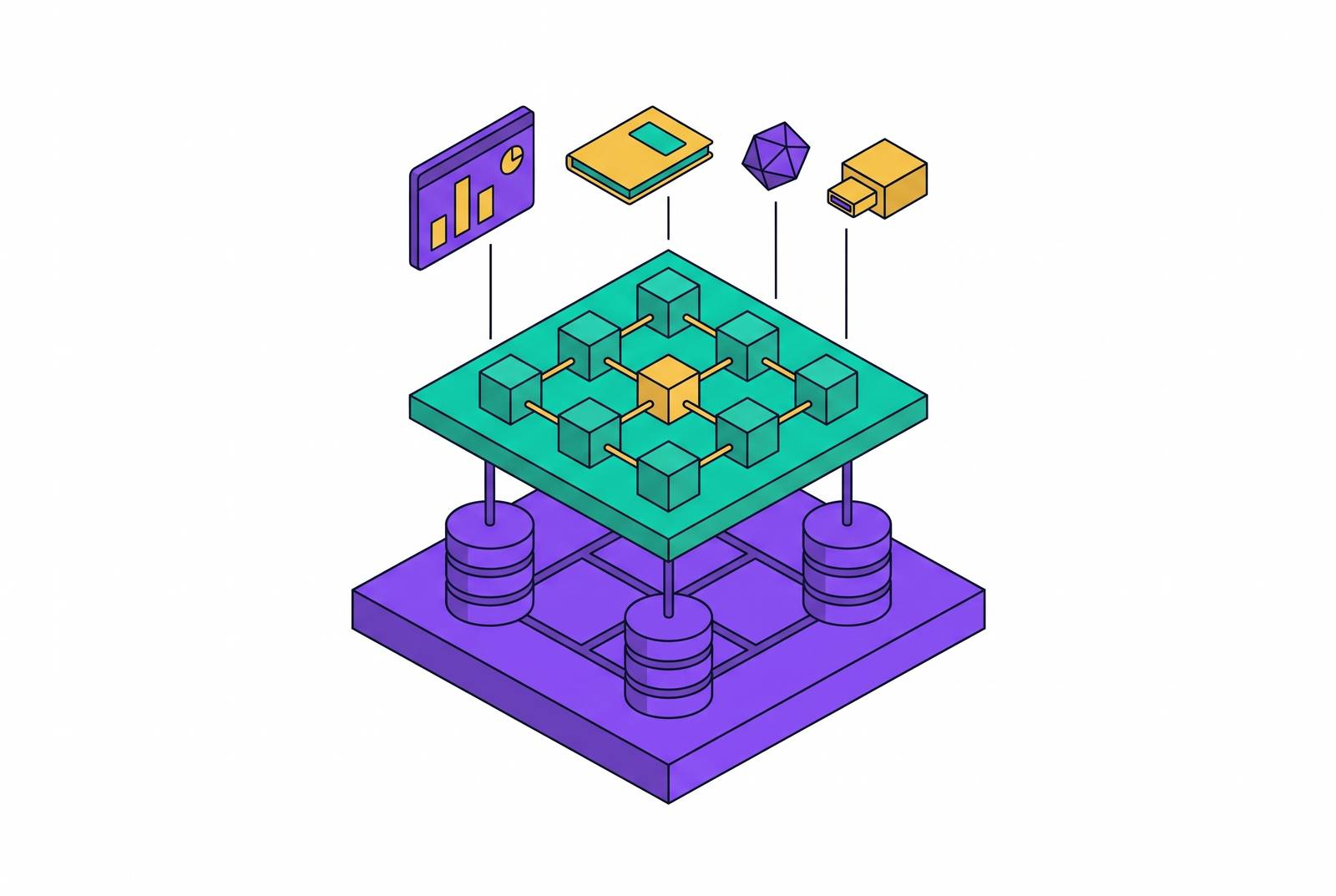
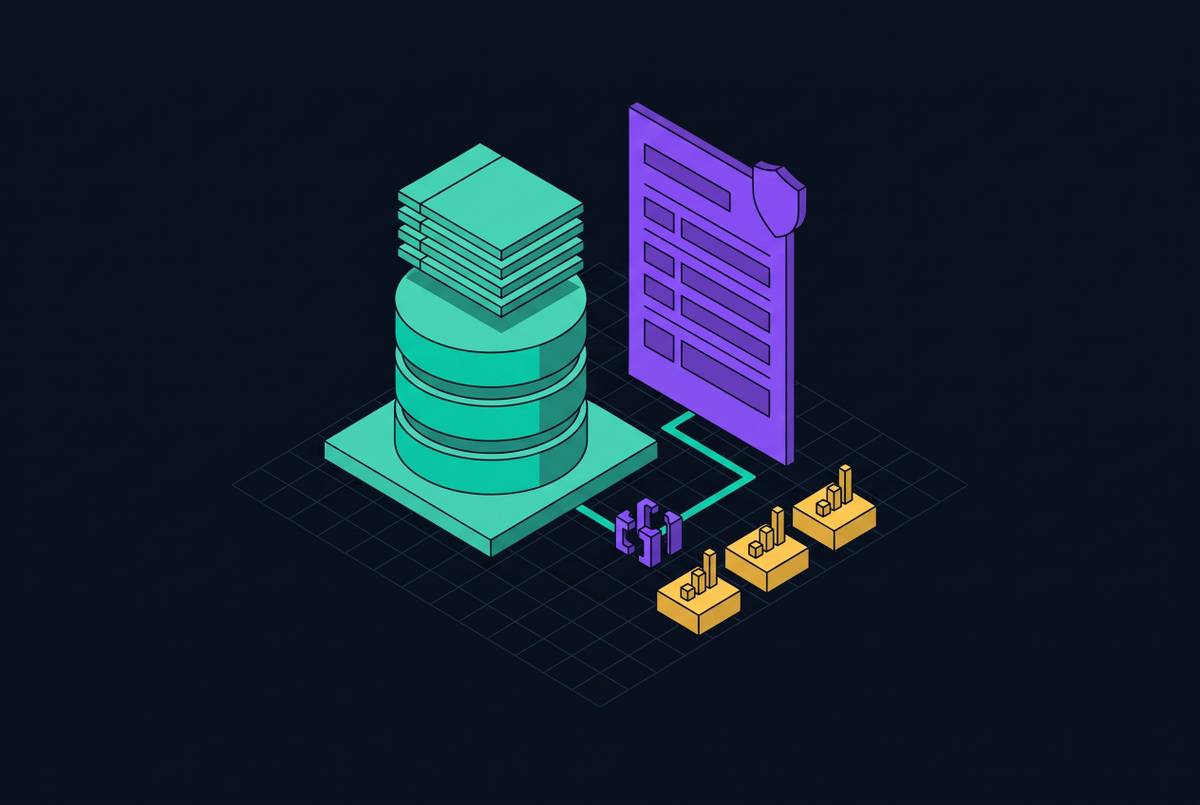
For API-first and agent-first teams already using Postgres as their data plane, the best-fitting headless analytics backend serves pre-modeled, governed metrics over APIs without imposing a frontend. It earns its place by extending Postgres’s existing controls without forcing schema changes, team-operated ETL pipelines, or production query risk. Full API access is useful only when metric definitions, permissions, and workload isolation remain intact.
Why headless analytics means something different when Postgres is already your data plane
Postgres already provides governance, lineage, and access control when it is the operational center of the stack. An analytics layer has to work with what is already in place. Headless BI separates metric definitions from presentation so that dashboards, notebooks, and agents can request the same governed calculations over APIs.
The input architecture remains a separate question. “Headless” describes the output contract. A layer that extracts data into another store imposes different responsibilities from one that works within Postgres. The distinction becomes especially important when the database already anchors the team’s controls and operating practices. Does the proposed layer extend that foundation, or duplicate it and add overhead?
What production Postgres analytics actually breaks on, and why the layer must solve this first
Production analytics fails along several connected paths. Analytical requests compete with operational traffic, and agent queries can use up connection pools when both workloads hit the same instance. As concurrency grows, analytical latency becomes another constraint. A fast query in isolation does not establish that the production database can sustain many simultaneous analytical callers.
Access and meaning can fail independently of performance. Agents with direct table access but no semantic context must guess what a metric means, while separate teams can encode different definitions of the same business term. Row-level security introduces another boundary when agent access depends on reconstructing those controls at query time. This can lead to RLS bypass and conflicting answers even when queries run successfully.
Source and copy can drift, pipelines require reliable operation, and unmanaged replication slots can retain enough WAL to fill disks. These are not interchangeable problems, and lower query latency does not resolve all of them. A headless layer earns its place by preventing these specific outcomes behind its API.
Whether the layer pre-models metrics or just moves queries
The most consequential distinction is whether a layer establishes reusable metric definitions or simply relays ad-hoc queries faster. If separate teams define “active user” differently, a router can faithfully return three different answers to three different callers. A semantic layer instead makes that term resolve to one calculation across consuming surfaces. For multiple teams or agents, this is an architectural requirement.
Pre-modeling gives the calculation a durable home. Its output can be a governed Parquet dataset, a materialized view, or a named metric object that consumers query without reconstructing the underlying logic. A routed query, by contrast, can produce a result that exists only in its response. The distinction is not simply whether SQL runs quickly. It is whether the meaning of the result exists independently of that request.
Coalesce’s 2025 playbook describes metrics such as revenue and gross margin percentage as calculations that have names and spell out their grains, filters, and time semantics. Those details define what a number represents and allow the calculation to be reused across tools. A name alone is not enough. Two calculations called revenue can still disagree if their filters or time semantics differ, so the governed definition must contain more than a label.
Agents make this requirement especially clear because direct access to tables does not supply business meaning. An agent asked for usage analytics needs both permission to inspect rows and a definition of the requested metric that is already in place. A pre-modeled dataset supplies that human-established calculation without requiring a prebuilt dashboard UI. It removes the need for the agent to invent the metric’s logic, though it does not make every interpretation of the result correct.
Does the layer store a versioned metric definition independently of the query that produced it? If not, it is functioning as a router. Faster access can still be useful, but it does not prevent consumers from defining the same business term differently.
Whether it keeps agent traffic away from the production instance
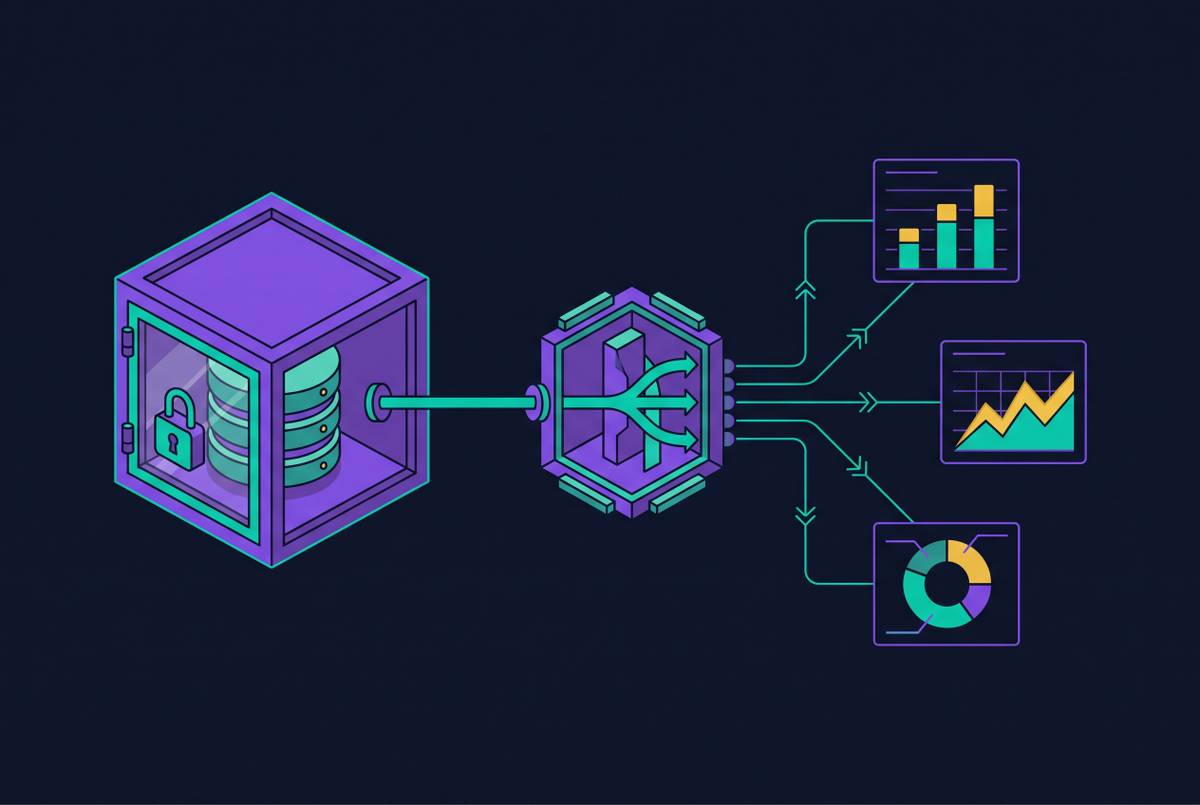
An agent-facing analytics layer must keep agents on a governed analytical copy isolated from the production database. Anthropic introduced MCP in November 2024 to give agents a standard way to communicate with external data sources, and major AI platforms support the protocol. It standardizes connectivity, making safe access more urgent as data becomes easier to reach.
In this design, the MCP server sits over the governed copy. Agent traffic then scales on its own path instead of competing for OLTP connections on the production instance. Pre-modeled datasets also let agents inherit the governance applied at modeling time rather than reconstructing row-level security for each query. That protection depends on the governed dataset and exposed interface.
Tool scope provides a second protective boundary. An interface that allows only a metric name, allowed filters, and available dimensions keeps the agent from making requests outside those permissions, while raw SQL access allows more kinds of queries. The July 2026 MCP specification revision added a stateless protocol design that lets requests reach any server instance behind a round-robin load balancer. That simplifies access-layer scaling but does not replace the governed copy underneath. Evaluation must establish whether separation from production is enforced by design or left to caller configuration.
Does the layer work within Postgres, or require extracting data from it?
Xata’s 2026 build provides a concrete starting point. Identity data, product usage, billing, and PostHog events were scattered across four systems with no way to join them. The build used vanilla Postgres, materialized views, pg_cron, and database branches to create a functional product analytics warehouse for onboarding, activation, and product decisions. It did not require a dedicated OLAP system.
ClickHouse’s guide identifies sub-100 ms p95 latency at high analytical concurrency as the customer-facing analytics threshold. Postgres with materialized views can reach that threshold at small to medium scale, but not under linear concurrency growth from many simultaneous users. The sequencing recommendation is to start with connection pooling and read replicas, with analytical separation occurring before p95 query latency becomes a problem. Working within Postgres is not the same as sending every request to the production instance.
The choice to extract data should rest on what the team has to run, whatever the database is called. A layer that pre-models metrics into governed Parquet datasets queryable through DuckDB moves compute without requiring the team to build and maintain a replication pipeline. A layer requiring CDC, a replication slot, and a separate columnar store creates a different commitment. Managed CDC connectors reduce replication-slot and WAL-retention risk but do not eliminate it.
For evaluation, the lesson is to map the complete path from Postgres to the query result. That assessment must include every component the team has to run, monitor, version, and recover. The strongest fit is the option that meets the workload’s needs without adding infrastructure complexity beyond what the team has deliberately committed to operating.
Whether metric definitions are versioned and enforced the same way code is
A layer can isolate agents and avoid a team-operated extraction pipeline while still leaving definitions inside dashboard formulas or ad-hoc queries. Those definitions remain local conventions, vulnerable to divergence when another team writes its own calculation. The governance requirement is a versioned, reviewable definition and serving-time enforcement that prevents consumers from receiving results based on unauthorized or superseded definitions.
The same playbook describes a data dictionary in which every metric has one named, documented source of truth. Even an early-stage B2B SaaS team with a small KPI set needs to follow that practice. ARR, churn, CAC, LTV, and gross margin can diverge across teams without governing definitions. SUM(revenue) and SUM(amount_captured) illustrate how calculations themselves can disagree.
Permission timing introduces a separate structural distinction. A layer that checks permissions after a query exists can block execution or return an error after resources have been consumed, and some execution-time approaches can return partial results. A layer that checks before planning can make an unauthorized query structurally impossible. A database record or YAML file in Git must be assessed for versioning and review, while the serving path must be assessed for enforcement before or after query planning.
Whether the layer serves both human and agent consumers from the same governed dataset
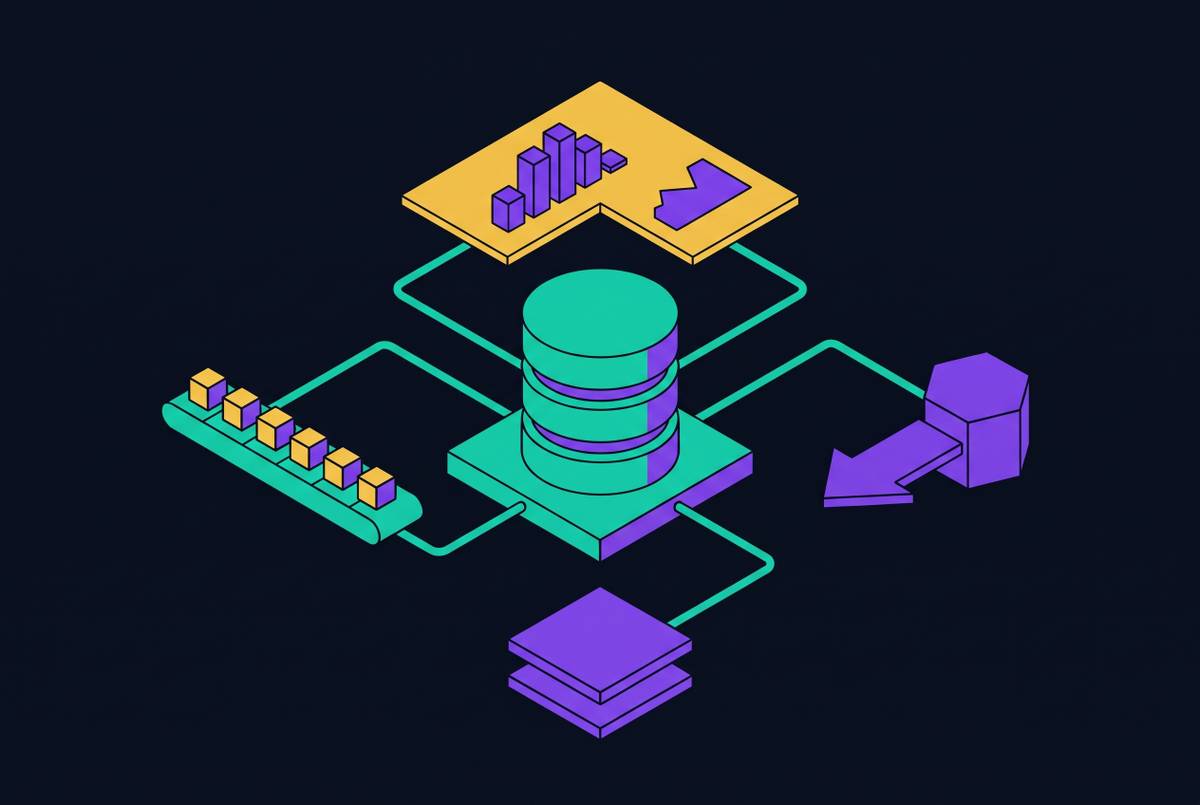
Separate datasets for dashboards and agents create a synchronization problem and leave no single source of truth. Shared metric names do not remove that split. The architectural requirement is one governed dataset available to dashboards, Slack notifications, agents, and API callers, so the same request resolves to the same answer. The metric a human reads in a weekly report should be the same governed object an agent reads when asked to flag an anomaly.
An MCP server can make that shared dataset available with the same definitions used by the tools people use. Provenance attached to each result then gives the agent a source it can cite. No opinionated frontend is required for this arrangement. API control sets how consumers get metrics, while governance sets what those metrics mean and who may get them.
Metrics pushed to an inbox, Slack, or a scheduled report are more likely to be acted on than metrics that require someone to remember to query. A pull-only API lets consumers get metrics but still leaves them to ask for those metrics. The evaluation should check whether the design ensures that human-facing and agent-facing endpoints query the same underlying dataset or leaves that to how they are configured.
A practical evaluation checklist for Postgres teams comparing headless analytics options
The first question concerns the metric’s independent existence. Does the layer store a versioned definition separately from the query that produced it, or only route queries faster? The second concerns agent isolation. Does the MCP or agent integration query a governed analytical copy, with architecture enforcing separation from production independently of caller configuration?
The third question concerns the full operational footprint. Which components must the team run, monitor, version, and recover between Postgres and the returned result? For teams building on Supabase and Postgres, this deserves particular scrutiny because Supabase’s value includes consolidating infrastructure. Raw API access can be a good consumption fit while a required set of separate pipeline components undermines that operational simplicity.
Do definitions live in a versioned, reviewable store, and do permission checks happen before or after the query plan is built? The fifth asks whether the design ensures that human and agent consumers query the same governed dataset. These questions distinguish API availability from a backend that can preserve meaning, access boundaries, and consistency across consumers.
The recommended sequence is to install pg_stat_statements and p50/p95 latency dashboards before adding the analytics layer, so the team understands the database’s existing workload. PostgreSQL’s documentation describes pg_stat_statements as tracking planning and execution statistics for SQL statements executed by a server. The analytics layer then takes responsibility for the governed copy while that monitoring continues. This makes the decision accountable to both the metrics the layer serves and the production workload it must leave protected.